Showing posts with label dissertation preparation. Show all posts

Friday, May 3, 2019

It's in the Guidelines, Part 2: "Use them, or you'll do it wrong."

by Robyn Byrd


In last month's "It's in the Guidelines," Tiffany explained how to access our many resources on the Thesis Office website. Knowing where to look up formatting help will save you a lot of time. Now, I want to add to her post in order to stress the importance of actually using these guidelines. That is, the guidelines not just there for you to look at them if you feel like it. They're there because you NEED to look at them. In the words of one of our Thesis Office mottos, "If you don't use the guidelines, you'll do it wrong."

For instance, you'll start off on the wrong foot from the get-go if you don't look at the abstract and title page templates. How in the world would you figure these things out by guessing? You wouldn't!
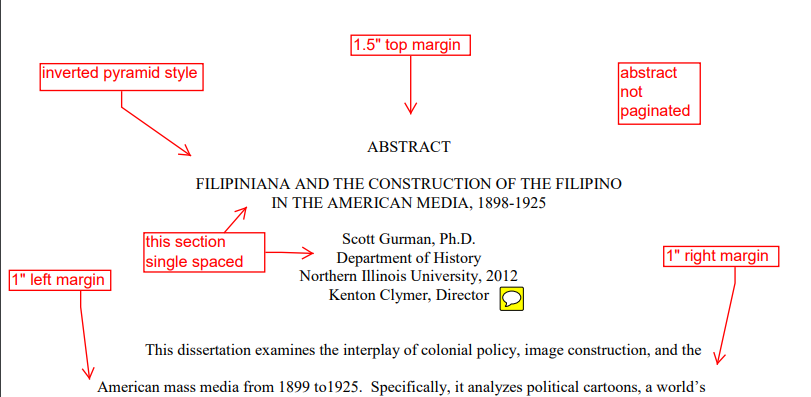

All successfully defended and submitted theses go through a revision process with this office. Why? To fix the formatting...which is explained in the guidelines. (I apologize if this is giving you flashback to "IT'S IN THE SYLLABUS"). Many students are surprised by how much more work they need to do. When they think they are completely done because they had a great dissertation defense, and then find out they have to make scores of corrections, it's kind of a buzzkill. If you've submitted your defended document on time, you will still graduate! But, the better that document looks at the time of submission, the more headache you'll save yourself. You should be planning a graduation party or looking for a job, not tweaking margins and re-labeling tables and setting fire to your laptop.

For another example, see the figure below. Figures and tables are labeled differently. Figures have the number and title below, while tables have them above. There are also different conventions for naming each, and their placement within the document. Did you think about that before? Some published students already know about such conventions, but many others do not. 

There is a reason that some journals look great and consistent from cover to cover. An editor followed exacting guidelines to get it that way. The Thesis Office has exacting guidelines so that NIU sends documents out into the world that represent the high quality of the graduate scholarship done here. We want you to look great, because you are great!

more guidelines...

Finally, the most common problem students come to visit us about is their page numbers. Unless you have published a book, you probably haven't had to wrangle page numbers a lot. We have a very informative video on how to do it, and the simple logic of it can save you hours. Check it out!

After seeing students' worst problems over the years, we know what needs to be clarified. Use the list of guidelines and the red-marked templates on our site, and you won't need to see so much red ink on your own document. Thanks for reading -- now go read the guidelines! 


Templates and Examples: https://www.niu.edu/grad/thesis/templates-examples.shtml

Video Tutorials: https://www.niu.edu/grad/thesis/video-tutorials.shtml

Friday, February 8, 2019

Coming this Spring to the Thesis Office

This term we are offering programs essential to the successful completion of your thesis or dissertation. Whatever stage you are in, from beginning the proposal to submitting the final document, we have a presentation that you should attend!

The best new thing this term? We are live-streaming some of our events to allow access to off-campus (or very busy) students!

All programs are led by experts in graduate school requirements, document formatting, and the general  woes and wonders of thesis writing! Scroll through these options and click the link at the bottom of the page to find registration details. (Most programs require registration)

Breaking Through Writer's Block and Other Obstacles

This informal discussion is designed to address common obstacles that slow or entirely halt progress in writing a thesis or dissertation. Carolyn Law, Thesis/Dissertation Advisor, will facilitate the discussion and offer practical strategies. You will leave with ideas to immediately use to break through your writer’s block. Also streaming live in the Facebook group NIU Theses and Dissertations.
 Wednesday, February 20 at 12:00 PM to 1:00 PM, Adams Hall, 103 

Writing a Dissertation in Education

This one-day program is designed specifically for dissertation writers enrolled in 799 hours in the College of Education. The Thesis Office staff will walk you through the Graduate School’s specific requirements for dissertations and cover a wide range of the most troublesome issues dissertation writers frequently encounter. There will be generous time for individual questions and one-on-one consultation. So, bring your laptop and specific questions to maximize the workshop's effectiveness.This program is the best way to ensure compliance with the Graduate School requirements. 
 Saturday, February 23 at 9:00 AM to 2:00 PM, NIU Naperville, Room 166 

Create and Nurture a Productive Thesis/Dissertation Committee

This presentation will address the process of choosing committee members, fostering strong working relationships with them, maintaining productive communications over the long haul, and managing faculty feedback to achieve steady progress toward completing your thesis or dissertation. In addition, Graduate School policies regarding committees will be reviewed. Bring your specific questions to maximize the workshop's effectiveness. 
 Monday, February 25 at 3:30 PM to 4:45 PM, Holmes Student Center, 405 

Thesis Essentials

This presentation is designed for all master's students enrolled in 699 hours. The Thesis Office staff will walk you through the Graduate School's specific requirements for theses and cover a wide range of the most troublesome issues thesis writers frequently encounter. There will be generous time for one-on-one consultation. This program is the best way to ensure compliance with the Graduate School requirements. 
 Tuesday, February 26 at 2:00 PM to 4:00 PM, Adams Hall, 103 


Dissertation Essentials

This presentation is designed for all doctoral students enrolled in 799 hours. The Thesis Office staff will walk you through the Graduate School’s specific requirements for dissertations and cover a wide range of the most troublesome issues dissertation writers frequently encounter. There will be generous time for one-on-one consultation. This program is the best way to ensure compliance with the Graduate School requirements. 
 Wednesday, February 27 at 2:00 PM to 4:00 PM, Adams Hall, 103

Demystifying the Thesis/Dissertation Submission Process

This presentation is for graduate students preparing to submit a thesis or dissertation to the Graduate School for May 2019 graduation. Carolyn Law, Thesis/Dissertation Advisor, will walk students through the steps of the process: defense, electronic submission, and final approval. 
 Monday, March 4 at 6:00 PM to 8:00 PM,  Founders Memorial Library, 297 


Problems in Theses/Dissertations: Tables/Figures/Pagination

This hands-on workshop is designed to assist thesis and dissertation writers to comply with the Graduate School requirements for tables, figures, and pagination. The Thesis Office staff will cover the specific format requirements, demonstrate helpful techniques and shortcuts in Microsoft Word, and allow generous time for individual troubleshooting and one-on-one consultation. So, bring your laptop and specific questions to maximize the workshop’s effectiveness. 
 Tuesday, March 5 at 2:00 PM to 4:00 PM, Adams Hall, 103 


Writing Your Thesis or Dissertation Proposal

Do you need to write a thesis or dissertation proposal? This interactive workshop will address typical characteristics of a successful thesis or dissertation proposal as well as practical strategies for organizing the key elements. Breakout sessions will allow for generous time for questions and small group discussion. Bring your laptop and specific questions to maximize the workshop’s effectiveness.
 Wednesday, March 6 at 3:30 PM to 5:00 PM, Holmes Student Center, 405 

See you there!

Friday, May 4, 2018

Announcing: Dissertation Boot Camps

A post-traditional NIU student
*trying* to work from home
This summer, for the eighth year, the University Writing Center at NIU is offering its Dissertation Boot Camps!

These camps are retreat-style workshops, presentations, and writing sessions for those who are in progress (past prospectus defense) on a dissertation in any field. What is retreat-style? That means you the Writing Center facilitates full-day schedules (from two days to a whole week), giving you dedicated writing time with interruptions from home life and other work. We all know it can be impossible to write at home with kids, pets, and responsibilities distracting us. Or even if you write at work... there is always other work! Dissertation Boot Camp is a chance to get away from everything that's been keeping you from writing, and work on your dissertation surrounded by peers with the same lofty goal: a done dissertation.
Quiet writing time in the lab
or around campus


In addition to long blocks of dedicated writing time (approx. 5 hours per day), Gail Jacky, director of the UWC and veteran writing tutor, will lead sessions on tackling writer's block, how to relax, and other common problems. Writing coaches will be available to give formal consultations and feedback, and talks with your peers can be just as fruitful.

Intellectual isolation from our family and friends can be almost as frustrating as not being able to find time to work around family and friends... so being in a cohort of dissertation-writing peers can also potentially alleviate the stresses of compartmentalizing everyday life and feeling alone in our struggles. Even if just for a few short days.

Schedules for the programs depend on the length of the workshop: the cost of the 2-day camp is $100, and the cost of the week-long camp is $250. Some writers decide to go ALL IN and stay overnights at NIU! The Holmes Student Center offers affordable lodging on campus, if your really need to get away and focus your time on your work.

Workshops run throughout the summer. You can make this fit around your summer vacation or work responsibilities:

Writers can chat, cheerlead, or just comisserate!
2-day Bootcamps

June 13-14
July 17-18
August 1-2

Week-long Bootcamps

June 25-29
July 23-27


Learn more at the UWC website, and email Gail Jacky with any questions!


Friday, March 23, 2018

The Graduate Degree: A Prelude to Knowledge Work


Investigating, analyzing, evaluating, creating, contextualizing, self-directing: skills like these are integral to the writing of a thesis or dissertation but also characteristic of the broad occupational domain called knowledge work.  To thesis and dissertation writers at any stage of their projects, below we offer thoughts on how you’re already developing—and can continue to develop—skills that are crucial for success in knowledge-oriented fields.

Tallies and Time Clocks?

Knowledge work is generally hard to quantify or measure.  Ironically, though, those who engage in such work across fields of academia tend to be fairly obsessed with counting and measuring.  Most carefully keep or monitor totals of papers presented, articles published, grants awarded, committees served on, and classes taught per year.  When you arrange your CV and the several accompanying documents needed for an academic job search, your field’s particular obsessions with such performance-related numbers boldly reassert themselves.  Other academic endeavors are sometimes summed up in terms of hours spent per week in classrooms, offices, labs, meetings, field investigations, grading sessions, or writing stints.

Yet the efforts that go into various kinds of academic production are not always easy to break down into regular time chunks.  Realistically, much academic work can keep the worker occupied from early morning to late at night, during parts of weekends, and during stretches of semester breaks.  (Let me briefly add that plenty in and outside academia do seem interested in figuring out the number of hours per week academics actually work—or in debating how many hours per week they should work.  A couple of recent reports (see here and here) suggest that such investigations and debates are complex and sometimes testy.  We avoid these issues in this post.)

Your Project: Training in Key Knowledge-Work Skills

A lot of what you do while completing your thesis or dissertation is obviously solid preparation for a future career in knowledge-centered domains.  As outlined and nicely detailed by the Careers & Employment Division at the University of Manchester, those aiming for a career in academia need to develop at least five skills for success.  Good news: as soon as you embark on your project, you’re immersed in an experience that can help you hone each of them.

Networking: As you develop relationships with members of your committee, each member can introduce you to others to help build your professional network.  In addition, while researching and writing, you can further extend your network by attending and/or presenting parts of your project at conferences.  Last year around this time, I traveled to a national conference to present a paper based on research for one of my dissertation chapters and attended multiple panels in areas central and peripheral to my academic interests.  The experience led to new contacts and eventually a request to submit a piece to a scholarly society’s publication.  Next month, I’ll travel to a regional conference to deliver a presentation with an NIU colleague and attend several discussion sessions.  You’re likely taking advantage of similar networking opportunities.  If not, seek them out.

Time Management: You’re already a knowledge worker and thus already weighing priorities and setting many deadlines of your own.  In previous posts on this blog, we’ve covered approaches to managing time during writing sessions, balancing your project with family matters, and maintaining your focus and enthusiasm by mixing work with recreational activities.  Consider such scheduling practices as sound preparation for the self-directed knowledge work of your post-degree career.

Resilience: While writing a thesis or dissertation, setbacks inevitably occur.  Data may need to be reanalyzed.  Ideas and approaches may need revamping.  Feedback on your progress from committee members—or from attendees at academic conferences—can be encouraging but also humbling.  As you get closer to the project’s completion, you’ll likely start looking for your postgraduate job.  Academic job hunting is especially fraught with pressures, rejections, and disappointments.  But lows like these that you experience throughout your project build your patience and resilience for similar wrinkles you’ll face down the road.

Presentation Skills: As a knowledge worker, you need to be able to present ideas clearly, in a variety of settings, among colleagues but also among people unfamiliar with intricacies of your work.  Each time you revise a section of your long document, you add useful material to your expanding pool of well-articulated expressions of your findings.  And you shouldn’t just aim to present them at your defense—another reason to plan to present at conferences while completing your project.  If you’re teaching, consider ways to integrate insights from your developing work in the classroom.

Project Management: At the NIU Thesis Office, we stress the value of being proactive in managing your thesis or dissertation project.  In a previous post, we featured a review of a useful book that describes the project-management approach to the dissertation.  Ultimately, you’re the manager of your project—under supervision of your director, of course.  The management experiences you gain now will certainly inform many aspects of your future knowledge-oriented employment.

Final Thoughts

Happy investigating, analyzing, evaluating, self-directing, and writing to all.  And good luck to those of you defending over the next few weeks!

Friday, February 23, 2018

Explain Your Project. You Have Three Minutes.


You’ve probably heard of the elevator speech: a short summary of an idea that you can pitch to someone (a prospective business partner, for example) while waiting for and then sharing an elevator.  You may even have crafted (or thought of crafting) a variation on the elevator speech for your thesis or dissertation project.  But have you worked out just how long this short speech should be?  Length is part of the official name for an increasingly popular speech contest that challenges grad-student participants to craft such a presentation: Three Minute Thesis (3MT®).  Details behind the 3MT speech are well worth exploring.

Hatched in a Shower?

A decade ago, experiencing a severe drought, people in Queensland, Australia adopted several ways to conserve water, including limiting showers to three minutes.  During those parched days, it seems that Alan Lawson, an emeritus professor and graduate school dean, was glancing at a three-minute egg timer attached to his bathroom wall when he suddenly found inspiration for the Three Minute Thesis.  This account of the humble beginnings of 3MT, now an international academic speech competition, doesn’t stray too far from historical information provided by the University of Queensland, the birthplace of 3MT.  Contests are now held in 62 countries outside Australia.  The contest in a nutshell: grad-student contestants must present their projects in three minutes.  If a contestant chooses to use visual support, it must take the form of a single, non-animated PowerPoint slide, displayed when the contestant starts speaking.  (No other visuals or props permitted). Currently 237 universities in the U.S. participate, including the University of Kentucky, which shares several informative videos derived from their past 3MT events.  Currently there are only three institutions participating in Illinois: UIC, ISU, and SUIC.  Last year’s contest at SUIC was the first one ever held there.

Competition Aside...
.
Competing is a primary goal in a 3MT event.  Ultimately, however, becoming a 3MT winner is beside the point.  Preparing such a speech is its own reward, valuable now and in the near and distant future.  How so?  Think of all those times over the past few months (or more) when you’ve found yourself explaining the project you’ve been working on to colleagues, friends, and family members.  Wouldn’t it be great to rattle all that off smoothly in three minutes (or less)?  Or picture your upcoming defense, an event that will be open to the public.  At the start, you’re going to need to summarize and rationalize your project to your committee members, your outside reader (if defending a dissertation), and other attendees in a meaningful and concise manner.  You’ll most likely have more than three minutes to do this, but why not practice so that you can capture your project’s essence in such a short amount of time?  Further, when you go on the job search and eventually become a finalist candidate, you’ll need to be ready to give a three-minute, one-minute, or 30-second summary of your project, depending on circumstances during interviews, presentations, and/or informal meetings at your prospective place of employment.  Why not pull together the longest of these short summaries now?  If you can explain your argument cogently and completely in three minutes (or less), you keenly demonstrate expertise in your field, familiarity with your areas of specialty, and a firm grasp of your project’s place in scholarship.  That is, you constructively crystallize the significance of your thesis or dissertation research.

Drafting and Organization
.
When you set out to create an effective three-minute thesis speech, consult the guidelines and judging criteria that Queensland provides.  As emphasized in those materials, a successful presentation centers on listeners’ needs: it starts off by creating a bridge to their interests, avoids jargon, summarizes important research outcomes, and ends by inspiring a desire to know more about the topic or to take some kind of action.  To meet these goals, arrange your presentation so that it answers the following questions:

     * Why is your research important to your listeners?
     * What brief examples best illustrate your project’s outcomes?
     * After hearing about your project, what should listeners do next?

An effective visual-support slide supports your message clearly, simply, and concisely.

Stand on Shoulders 

A famous speaker once responded to a request for a formal speech by saying, essentially: “If you want me to talk for three hours, I’m ready today.  If you want me to talk for only three minutes, I’ll need two weeks to prepare.”  Mark Twain is commonly associated with this quotation.  Words to the same effect (with variations) have also been attributed to several other celebrated orators: Abraham Lincoln, Benjamin Disraeli, Oscar Wilde, George Bernard Shaw, Winston Churchill, Will Rogers...and on and on.  In short, plenty of sharp wits are popularly linked to an important communication principle, which the 3MT contest underscores: expressing big ideas compactly requires careful thought and planning.  As you progress toward completing your program, follow the footsteps of accomplished speakers.  Give yourself ample time to prepare a good—and short—presentation of your thesis or dissertation.

Images: CC0 and Public Domain

Friday, December 1, 2017

The Drive You Save May Be Your Own


From start to finish, the thesis or dissertation is an arduous journey fraught with highs and lows.  Along the way, many things require special care, including even the computer device(s) on which you save your important work.  For many writers, the principal means of storage is a USB flash drive.  Words to the wise (and reminders to the conscientious): flash drives are a convenient but by no means failsafe storage option.

Nothing Lasts Forever

If you’re like me, you devote much of your attention these days to drafting and revising your dissertation.  You depend on a flash drive to store your work as you go.  You rarely consider flash-drive wear and tear.  But you should.  Think of all the places such devices regularly visit: in between connections to various USB ports, they spend time in pockets or backpacks or on table surfaces alongside other objects large and small.  Drives that hang with keys on a keychain experience another broad assortment of surroundings.  Imagine the bumps and variations in temperature flash drives regularly encounter.  Note that such stresses can gradually weaken the connection between a drive’s plug and its body.
Inside a flash drive

This connection is partly mechanical, partly electrical.  It involves a short row of tiny lugs.  They’re soldered atop the surface of a small internal circuit board.

I became keenly aware of such technical details of the typical flash drive about two months ago when the plug on mine—a drive on which I had been saving enormous amounts of precious data—suddenly snapped off.  In one stroke, recent notes and chapter drafts became instantly inaccessible!  A mammoth tornado swept through Research Avenue and knocked down Dissertation Hall, the home I had been digitally building for over a year on the remarkably vulnerable grounds of a flash memory chip.

Flash Drive Fiasco Headed Your Way?

No, you’re safe.  Clearly you won’t suffer such a catastrophe if you always handle your flash drive with tender loving care and keep it in a special place when not using it.  Or if you regularly back up files on your drive to other storage media (in accordance with the First Law of Safe Computing).  And of course you’ll avoid flash-drive horrors if you never store files on such a device to begin with and instead save everything to your hard drive…and/or external backup drive…and/or the cloud.

Yes, you’re flirting with disaster.  Again, however, if you’re like me, much of your attention nowadays centers on revising and composing your big writing project.  When you’re in the thick of all that and moving from home to office to library and back, plans for a rigorous storage routine fade into the background.  You easily fall back on the familiar habit of quickly and simply saving to the flash drive (and often forget to make backups).  Actually, in the Thesis Office, we’re quite used to working with grad students well acquainted with this habit.  Those who stop by for help with editing or formatting typically bring their working drafts (and many other important files) on what appear to be well-used and fully-loaded flash drives.

Flash Drive Recovery

What can thesis or dissertation writers do if most or all of their saved writing vanishes when their flash drive snaps in two—or otherwise fails?

Closeup of my wreck, post recovery. 

In my case, after it quickly became clear that I myself wouldn’t be able to repair the damage, my first stop was a DeKalb computer shop.  For a small fee, the attendant there soldered the USB plug back onto the drive’s circuit board.  But no luck: now Windows wouldn’t recognize the drive!


Flip-side view.  So much data in one little chip.

Was all my data really gone forever?  He then calmly referred me to an out-of-state recovery service.  I soon learned that data recovery experts can fetch fees that range from the livable to the breathtakingly astronomical.

Eventually I located a different and more feasible service online.  (Details on such services are plentiful on Google.)


Preventative Measures

Save to the cloud.  This well-known and sound advice, noted above, is always worth repeating.  One way to integrate cloud storage into everyday flash-drive usage is to set it up to run automatically.  Look for shareware or software that enables automatic uploading of files from your USB to Dropbox, OneDrive, or other cloud storage services. (Several such options are easy to track down on Google.)

Make regular backups.  You’re likely familiar with ways to configure Windows to perform automatic backups of your computer’s hard drive.  Note that relatively inexpensive software programs exist that also enable you to back up data automatically from your USB drive to your hard drive.

Remove safely.  Obviously, you should be gentle when removing your flash drive from USB ports.  Never remove the drive while a file is being written (or copied) to it.  And despite any optimizations you may have set on a Windows machine for quick removal, always right-click Eject and wait until you see the window that says the device can be safely removed before you unplug it. 

Long Story Short

In the end, I was able to recover all data on my damaged flash drive, but not right away and not without considerable misery and embarrassment.  If you ever face such an exasperating (but largely preventable) dilemma, know that recovery is possible...but not always certain.  Scribe carefully.


Friday, October 13, 2017

Video Tutorials Are Here!

You'll find a new page at our Thesis and Dissertation Office website: Video Tutorials!  Robyn and Fred spent the summer designing step-by-step guides to some of the most frequently used Microsoft Word tools for theses. Here, you'll find videos on:
  • Page Numbering: Proper pagination (creating page numbers and hiding page numbers) in your document
  • Leader Dots: Creating rows of leader dots (......) to build a professional-looking Table of Contents and other tables
  • COMING SOON, Landscape Pages: Working with landscape pages to accommodate your tables and figures

Don't get as frustrated as Fred! Watch our videos!
We use on-screen help plus live video of real people (us!) to guide you through every step of these processes. Watch the videos at full speed, slow them down, or watch as many times as you need to in order to learn the processes. Also, we have carefully captioned each one so you can watch without sound. We chose the videos we made based on what we've seen come through the office -- page numbers out of control, margins obliterated by big tables, and Tables of Contents with MS Word weirdness everywhere. When we see these problems, we sometimes have to tell a student the last thing he wants to hear: "We need to start from scratch." With these videos, we're trying to nip bad formatting in the bud. 

Fred's award for his blockbuster,
"Page Numbering"
We try to have a sense of humor to help lighten up what can be a boring and lengthy process. We don't love formatting either, but we'll help you learn to like it just a little better!  As one of our recent graduates said after spending weeks formatting his dissertation, "I should get a degree just for that!"

So before you throw the laptop out the window, avail yourself of these new videos. And if that doesn't work... come see us! We'll be glad to help in person, too. (No autographs, please.)


Friday, June 2, 2017

Writing Outside: Healthy Now and for the Long Haul

Composing al fresco, Shabbona Lake State Park

In our last post, we shared several helpful ways to overcome the terror of the blank page and fill it with words.  Here we offer a somewhat related tip: often you can effectively recharge your writing by taking it outside.

Outside?

Absolutely.  In the fresh air, under natural light.  Preferably somewhere relatively open so that walls don’t separate you from the expanse of your natural surroundings.  At nearly any stage of the thesis or dissertation, you can benefit from spending quality time in open-air settings that are suitable for relaxing but also walking, running, and cycling.  You may question the idea of bringing anything related to your project to such locales.  Yet this approach can often be just what you and your writing need, especially during times your progress slows down or your energy runs low.

Why?

Introducing your writing to outdoor settings can restore its vigor and rebalance your approach to it.  The thesis or dissertation tends to keep you indoors and narrowly focused for long stretches.  Granted, most of the work requires a lot of desk time.  But too much of that can dull your body, mind, and ultimately your writing.  Although there are many ways to take breaks, spending time outside can be especially rejuvenating.  “In the woods, is perpetual youth.”  Ralph Waldo Emerson offered that statement in his 1836 essay Nature as a way of introducing perhaps his most celebrated image dealing with the individual and the outdoors: “Standing on the bare ground,—my head bathed by the blithe air, and uplifted into infinite space,—all mean egotism vanishes.  I become a transparent eye-ball; I am nothing; I see all.”  Fanciful interpretations aside, Emerson’s idea hints at what you and your project can gain through outdoor excursions.  Certainly there is much to see and appreciate in nature.  But getting out in it can also help you see and appreciate your growing text more clearly.

How?

Among the many approaches to taking writing outside, the following are useful for immediate gain as well as long-term success:

Meditation on the Move.  Here you explore your thoughts about your writing (or anything else) while traversing outdoor surroundings on foot or bicycle.  This approach is particularly helpful during drafting and revising stages, that is, while you’re building and/or rearranging ideas.  As noted in a previous blog post, the term for this approach comes from writer and long-distance-running enthusiast Joe Henderson.  Fundamental to it is the principle that time spent thinking and moving is more important than mere distance covered: thus, aiming to get outside for 1 to 2 hours is better than aiming to complete a certain number of laps or miles.  As you meditate on the move, it also helps to note beings and objects in the distance, such as birds on branches, fish under water (often quite visible in certain sections of the Kish south of the NIU campus), clumps of faraway trees, or clouds on the horizon.  In addition to helping you stretch your mind, such distance viewing can give a welcome break to your eyes, which already spend plenty of time narrowly focused on words, pages, and screens.

Outdoor Journaling.  During a walk, run, or ride, stopping to make notes in a journal can be a very rewarding practice.  A journal allows you to put down ideas on the spot that might not come back to you when you later return to your indoor writing.  Out in nature, a pen and a pad of paper can reassert their handiness as writing tools.  Natural light can reengage your interest in your handwriting as well as the thoughts you express in it.  Of course, instead of such quaint holdovers from yesteryear, you could bring along an electronic writing gizmo.  But since you’re going outside partly to break away from routine, why not also temporarily disengage from such devices?  When you get down to it, working with writing on a screen outdoors, no matter how much you move in or out of the shade or adjust brightness settings, tends to be cumbersome and is often counterproductive.
 
Write by Windows.  Luckily, even while still working indoors, you’re generally never too far from nature.  Thus, obviously the quickest way to engage your writing with the outside world is to move to a nearby window and open it.  (Yes, even in cold weather.)  Simply composing by an open window can remarkably restore connections with your broader surroundings and thus ultimately also help revivify your writing.  It can also encourage you to venture further afield and take up some of the tips detailed above.

Wishing you continued success with your project as we head into the summer, perhaps the best season for taking your writing outside!


Friday, February 10, 2017

Thesis Office Outreach: Presentations, Workshops, Brown Bags

Two weeks into February, and here at the Thesis Office we’re ready to deliver our spring presentations, workshops, and brown bag sessions for writers at any stage of the thesis or dissertation process.  Below we give a rundown of what’s on offer over the next several weeks.  We look forward to seeing you!

Basic Info
Our programs are free.  Brown bags meet Wednesdays from 12 to 1 p.m. in Adams Hall, Room 103.  Workshops and most presentations will be held from 2 to 4 p.m. in the same location on Tuesdays or Thursdays, but note that two presentations (Writing a Dissertation in Education and Demystifying the Submission Process) will take place on different days and at different times and locations—see below. 

Registration
No registration required for brown bags.  Registration is required for a presentation or workshop.  Register via email at thesis@niu.edu.  Include the name of the presentation or workshop you want to attend in the subject line or message.  We do have space limitations.  Register early! 

What to Expect
Plenty of important information.  Many who experience these events walk away a bit surprised at the intricacies behind things like meeting various deadlines, submitting the proper paperwork to the proper place, or formatting the long document.  Expect thorough coverage of common concerns as well as ample time to address individual questions.   

Presentations
Thesis Essentials
Tuesday, February 21 (2 to 4 p.m. in Adams Hall, Room 103)
Designed for all master’s students enrolled in 699 in any department.  Staff will walk students through the Graduate School’s specific requirements for theses and cover a wide range of the most troublesome issues thesis writers frequently encounter.
  
Dissertation Essentials
Wednesday, February 22 (2 to 4 p.m. in Adams Hall, Room 103)
Designed for all doctoral students enrolled in 799 in any department.  Staff will walk students through the Graduate School’s specific requirements for dissertations and cover a wide range of the most troublesome issues dissertation writers frequently encounter.

Writing a Thesis in Engineering
Thursday, February 23 (2 to 4 p.m. in Adams Hall, Room 103)
Designed specifically for thesis writers enrolled in thesis-credit hours in the College of Engineering and Engineering Technology.  Staff will walk students through the Graduate School’s specific requirements for theses and cover a range of issues that students in engineering fields often find troublesome.

Writing a Dissertation in Education
Saturday, February 25 (9 a.m. to 2 p.m. at NIU Naperville, Room 162)
This one-day program is designed specifically for dissertation writers enrolled in 799 in the College of Education.  Staff will walk students through the Graduate School’s specific requirements for dissertations and cover a wide range of the most troublesome issues dissertation writers in Education frequently encounter.

Demystifying the Submission Process
Wednesday, March 8 (5 to 7 p.m. in Wirtz Hall, Room 104)
This presentation is for graduate students preparing to submit a thesis or dissertation to the Graduate School for May 2017 graduation.  Carolyn Law, Thesis/Dissertation Advisor, will walk students through the steps of the process: defense, electronic submission, and final approval.

Workshops
ASME Documentation
Tuesday, February 28 (2 to 4 p.m. in Adams Hall, Room 103)
This hand-on workshop will teach the documentation style of the American Society of Mechanical Engineers, known as ASME journal style.  Using real-word examples, students will apply the principles in real time to their own writing.  ASME journal style is ideal for research documentation in all departments of the College of Engineering and Engineering Technology.

Problems in Theses/Dissertations: Tables/Figures/Pagination
Wednesday, March 1 (2 to 4 p.m. in Adams Hall, Room 103)
This hands-on workshop is designed to help writers comply with the Graduate School’s requirements for tables, figures, and pagination.  Students should bring their work in progress on their own laptops.  Staff will cover the specific format requirements, demonstrate helpful techniques and short-cuts in Microsoft Word, and allow generous time for individual troubleshooting and one-on-one consultation.

Brown Bag Sessions 
Committee Relations
Wednesday, February 15 (12 to 1 p.m. in Adams Hall, Room 103)
Informal discussion on choosing committee members, creating productive working relationships with them, maintaining good communications, and managing feedback throughout the process.  Graduate School policies regarding committees will be reviewed.  Faculty and students welcome.

Breaking Through Writer's Block (and Other Obstacles)
Wednesday, February 22
(12 to 1 p.m. in Adams Hall, Room 103)
Informal discussion on common obstacles that slow or entirely halt progress on one’s thesis or dissertation.  Carolyn Law, Thesis/Dissertation Advisor, will facilitate the discussion and offer practical strategies.  Students only, please.

The Balancing Act: A Life in Grad School
Wednesday, March 1
(12 to 1 p.m. in Adams Hall, Room 103)
Informal discussion on the complexities of managing life as a graduate student, balancing family responsibilities, personal health, outside work, and the pressures of a dissertation or thesis.  Session will be facilitated by Thesis Office GA Robyn Byrd, doctoral candidate and mother of two.  Students only, please.

Friday, January 13, 2017

Coming Soon to a Thesis Office Near You


Warm Greetings and Happy New Year!  A quick hello to let you know what's to come this spring at the Thesis and Dissertation Office:

Video Tutorials
This past week our office shifted to production mode and put together our first pair of video tutorials on common questions and concerns about document preparation and formatting.  Soon-to-be available attractions include a short video on formatting leader dots in tables of contents (or similar lists) and a slightly longer one on the sometimes tricky business of formatting page numbers in a thesis or diss.  Stay tuned for further updates!

Spring Presentations and Workshops
We start these again in early February.  Check the NIU Events Calendar for details.

Ongoing Assistance with Your Thesis
Remember--we're available for personal consultation Monday through Thursday from 10 to 2 in Adams Hall, Room 104.

And coming at the end of January to this blog: a guest post by former Project Thesis blogger and recent Ph.D. graduate Michael Yetter.

Friday, November 18, 2016

Book Review: Writing the Doctoral Dissertation

At the beginning of any dissertation journey, both the journey and its destination seem hazy and amorphous. As the years of coursework rolled by, I had felt as if the diss was a huge, distant thing on the horizon that was painfully, slowly coming into view. It started to take a shape, and it became more and more real as I could see it looming there. But when I found myself close up, at the end of coursework, at the top of the field exam climb, I realized it wasn't a thing at the top of that mountain. I looked out across another chasm instead, with no clearer image of what the diss really was than before all my hard work.

Enough of that! I won't deny that this poetic sort of thinking about dissertating can be helpful, and is my usual mode as an English major. But especially as a disorganized English major, and as anyone in any discipline who has ever had trouble seeing the clear shape and scope of a project, I needed help thinking practically. I needed help making a plan. There are so many good books on the market, but many of them are titled in metaphorical language, some inspiring, some terrifying: Survival Guide! One of the books in our office has a cover image of a stormy sea with a flimsy lifesaver floating on it.  No thanks.  My dissertation is not the Titanic.

In Writing the Doctoral Dissertation: A Systematic Approach, the dissertation is not characterized as a "quest" or a "trial by fire" or anything other than what it is. It's a writing project! The book turns the diss into a procedure, like any other.  A procedure with linear steps (some cyclical ones too), with deadlines, and with clear goals. Gone are the musings about "demystifying" the "journey" or some other useless crap that a person in the throes of drafting could have thought of themselves.  If what you need is a clear, disinterested voice, untinged by commiseration or by condescension, to say to you "DO EXACTLY THIS"... then this is the book you should read.

Also, this book is fairly new, like of-this-decade new.  Its authors know about current trends in scholarship in various fields, alternative sorts of dissertations, and contemporary expectations for research in an age of globally accessible information and project collaborations.

In my youth I was always the straight-through writer, never an outliner. In grad school I began to see the purpose of having a structure and some goal-points in mind before beginning a project. But I never put that to use beyond the twenty or so pages required for my term papers.  Assorted piles of papers with color coded post-it notes were enough semi-organization to get me through. But now, as I face this new ~200 page project (journey, chasm, abyss, whatever you want to call it), this book has me obsessed with the checklist, the calendar, the breakdown, and even the "budget" of the dissertation.  In a very good way.

Writing the Doctoral Dissertation: A Systematic Approach (by Gordon B. Davis, Clyde A. Parker, and Detmar W. StraubBarron's, 2012) is available online and in the NIU bookstore.  Here is a summary from one of the contributors:

http://www.gs.howard.edu/sbe/text/reading5.pdf

At $12.99 it will be one of your best grad school investments (or maybe a close second to the coffee pot).

Friday, November 4, 2016

The Nontraditional Dissertation and You

Opening panels of Nick Sousanis's dissertation.

By tradition, the dissertation is a text-centered project rooted in conventions established long, long ago during the early days of print. Perhaps you agree it's high time to overturn the old ways. Perhaps you're ready to see academia break free from the shackles of tradition and embrace dissertations that depart from the monograph or that combine text with images and other media.        

The Nontraditional Dissertation

Actually, contemporary dissertators have already started clearing such nontraditional paths, and coverage of these developments makes for some interesting reading. In an entry last June, our blog touched on stories of pioneers of various sorts who have approached the dissertation in novel ways; the first story is amusing but also alarming (detailing how politicians and other officials in Russia have been buying dissertations on the black market!), whereas the second is intriguing and rather inspiring (documenting dissertations that take the form of interactive digital texts or even comic books). The advent of the comic-book dissertation was further detailed (with plenty of eye-catching graphics) in this 2014 article by Sydni Dunn at The Chronicle of Higher Education. Dunn devotes much of her piece to Nick Sousanis’s Unflattening, a dissertation in comic form that Sousanis produced at Columbia University and subsequently turned into a book, published in 2015 by Harvard University Press. Sousanis is now a professor at San Francisco State; you can read more about his work on comics as educational tools on his detailed website. Finally, you can find an abundance of relevant articles and media clips on the website of the #Alt-Academy, a place for humanities scholars to share their experiences at producing unorthodox dissertations and embarking on nontraditional academic careers.

Where Do You Fit In? 

Regardless of your field, you may wish to pursue a nontraditional dissertation. When I initially heard that term, the first thing that came to my mind was some kind of creative piece that involves more than just written text, something like Sousanis’s comic-book dissertation or a performance-based project one might produce in fields such as dance, theater, or film. But there is certainly room for nontraditional approaches in other fields such as education, engineering, or health and human sciences. In fields like these, research and post-degree goals may fit in nicely with a project comprised of stand-alone articles, reports, or digital materials (instead of a unified set of dissertation chapters).

If you're contemplating a nontraditional route for your dissertation (or thesis), here are three main points to consider as you make your plans.

1. Acceptability. How enthusiastically will your committee members accept the idea? You obviously need to get approval from your director and other readers as you prepare your project's proposal. At this stage, you'll most certainly need to inform them of any plans you may have for out-of-the ordinary methods or innovative presentations of results.

2. Marketability. How will a nontraditional project enhance your short-term and long-range career prospects? 

3. Flexibility. How willing and able are you to make changes to your nontraditional document, your methods of displaying it, or to the way it mixes textual innovations with conventional formatting requirements? Note that certain features in complex multimodal files may not display effectively on platforms like ProQuest (or the file may exceed the size limit).   

And, by the way, if you're already working on a nontraditional project (or if you've completed one), we'd be thrilled if you told us a little about your experiences in the comments section below!

Nontraditional in Form: Your ETD 

Of course, compared to a traditional dissertation or thesis from the distant or even more recent past, the document you eventually complete will be inherently nontraditional: no matter how conventional or non-digital it is in execution (whether you develop it from handwritten drafts, lab experiments, fieldwork, studio sessions, or performances), you must convert the report of your defended piece (conventional, innovative, or somewhere in between) into a PDF file that can be read and distributed electronically. Remember that we provide step-by-step guidelines for submitting your file as an electronic thesis/dissertation (ETD) on our webpage. Good luck with all your work as you progress to that final stage!

Wednesday, October 26, 2016

Building Your Tribe (Again and Again)


If you're an average-aged grad student or older, you're a full fledged grown-up by now, whether you like it or not. Like me, you've probably realized that making friends as an adult is not like making friends as a young person. When we lose the easy friendships of our high school tribe, our college tribe, or even our bar-going, concert-going, or [insert any 20-something activity here] buddies, the road to a graduate degree can get lonesome. The sobriety of adulthood and of the graduate journey are two strikes against us as friend material.

What I've realized is that adults, especially in our line of work, need friends with common interests and similar goals. The exuberance of youthful friendships and the energy of their bodies and minds (and their staggering amount of free time) makes friendships of all kinds enjoyable and sustainable.  We can still have our old friendships. But as graduate students, we have a specific goal shared by a small percentage of the population. Not only that, our most passionate interests are only interesting to an even smaller, infinitesimal percentage of the population. It seems like we need to bust out the Venn Diagrams to figure out which of the people we know should still put up with us as friends!

The First Tribe: Get One!

When I say we need similar people in our lives, I don't mean vaguely similar. Like "We are both success oriented and outgoing!" similar. I mean SIMILAR. Like, "We both study the genome of a rare species of Bolivian rat!" similar. ...I'm kidding. But students in your department who share the same journey are the first place to look for camaraderie, if you are newly doing the grad thing. Attend lectures, talk to people after class, join a group, go out for drinks. At first it will be awkward. But we're all old enough not to care about being "cool"! So try really hard just to soak it all up. Be observant, and don't be competitive.  You are all in the same leaky boat.

In the English Department at NIU, we had a broad core of classes, no matter our focus, and I met many like-minded people. Among the TAs in particular, our shared experience of teaching composition to freshmen created a strong bond. (Working on campus and being a part of the department is priceless.) The coursework experience, and the combined experience of the first few years of teaching with people I also studied with, won me a new tribe. I can only hope that coursework and GA work is such a social boon for all early career grad students.

End of Coursework, End of Social Life?

That tribe disappears, all too soon. The MA students were gone in two years. I miss some of them a lot. PhD students who entered ahead of me, core members of my tribe, are off dissertating, locked away from social interruptions. Some have finished and moved far away.  I stopped driving to campus for the drink nights that used to be so easy to attend when they were right after class. Today, I have the solid support of my office, and the vague support of my family who have no idea what I'm doing. But I haven't much in the way of comrades. I feel like I'm writing all alone.

All I can say is don't let that happen. The involvement will diminish, but the time spent together is still important. At the stage of the thesis or dissertation we need so much more than commiseration and shop talk. We need support, strategies, hope, and human connection. We spend so much time with our research and our laptops. It's odd, really. But you know who won't think it's odd? The other people who do it.

Facebook groups (friend everyone!) are a great way to plan events and stay in touch, even when you hardly see each other in person anymore. Part of the reason I dropped out of the tribe was lack of transportation.  Well, I've got a new car! Writing this post has given me the urge to get back on social media and find some real-life social activities to do.

Other Ways to Connect

I know I just said you need grad student friends. But there are other kinds of specifically like-minded friends! That's my main thesis here --  we are not the best friend material right now.  So we should seek friendship that is as supportive as possible of our unique situations.

I have a social life outside of school, almost solely because I'm in rock bands. This is another way that I surround myself with people of very specific interests. Do you play? If not, you're probably not someone I see very often. It sounds bad, but we only have so much time, and we need to fill it with the right kinds of stimulation.  So in addition to your efforts on campus, finding a hobby and focusing on it can round out your social life better than aimless bar-going or online dating. Most of us can't turn our brains off, right?  So find something that stimulates a different part of it.  Art, geo-caching, gaming, hiking, whatever. A specific thing to share.

Someday We'll Be Normal (Sort of)

Someday we will finish our theses and dissertations. We can nurse neglected friendships, balance our lives out, and maybe even start eating real food again! I'm not arguing at all that high-achievers have no use for broader social circles and diversity among their friends. I'm just saying that right now, you need grad school friends. And the best way to find the ones who will help you along your journey is to simply look around at your fellow travelers.