Showing posts with label ETD. Show all posts

Friday, May 3, 2019

It's in the Guidelines, Part 2: "Use them, or you'll do it wrong."

by Robyn Byrd


In last month's "It's in the Guidelines," Tiffany explained how to access our many resources on the Thesis Office website. Knowing where to look up formatting help will save you a lot of time. Now, I want to add to her post in order to stress the importance of actually using these guidelines. That is, the guidelines not just there for you to look at them if you feel like it. They're there because you NEED to look at them. In the words of one of our Thesis Office mottos, "If you don't use the guidelines, you'll do it wrong."

For instance, you'll start off on the wrong foot from the get-go if you don't look at the abstract and title page templates. How in the world would you figure these things out by guessing? You wouldn't!
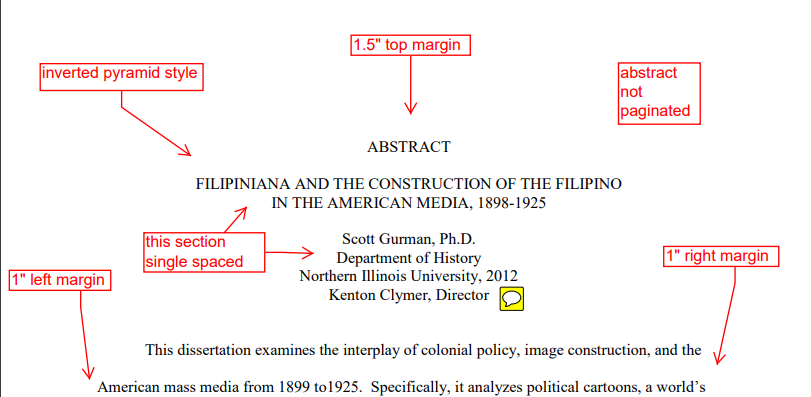

All successfully defended and submitted theses go through a revision process with this office. Why? To fix the formatting...which is explained in the guidelines. (I apologize if this is giving you flashback to "IT'S IN THE SYLLABUS"). Many students are surprised by how much more work they need to do. When they think they are completely done because they had a great dissertation defense, and then find out they have to make scores of corrections, it's kind of a buzzkill. If you've submitted your defended document on time, you will still graduate! But, the better that document looks at the time of submission, the more headache you'll save yourself. You should be planning a graduation party or looking for a job, not tweaking margins and re-labeling tables and setting fire to your laptop.

For another example, see the figure below. Figures and tables are labeled differently. Figures have the number and title below, while tables have them above. There are also different conventions for naming each, and their placement within the document. Did you think about that before? Some published students already know about such conventions, but many others do not. 

There is a reason that some journals look great and consistent from cover to cover. An editor followed exacting guidelines to get it that way. The Thesis Office has exacting guidelines so that NIU sends documents out into the world that represent the high quality of the graduate scholarship done here. We want you to look great, because you are great!

more guidelines...

Finally, the most common problem students come to visit us about is their page numbers. Unless you have published a book, you probably haven't had to wrangle page numbers a lot. We have a very informative video on how to do it, and the simple logic of it can save you hours. Check it out!

After seeing students' worst problems over the years, we know what needs to be clarified. Use the list of guidelines and the red-marked templates on our site, and you won't need to see so much red ink on your own document. Thanks for reading -- now go read the guidelines! 


Templates and Examples: https://www.niu.edu/grad/thesis/templates-examples.shtml

Video Tutorials: https://www.niu.edu/grad/thesis/video-tutorials.shtml

Friday, July 7, 2017

ProQuest: Your Publisher...and More


Picture yourself near your project’s end.  Writing completed and defense successful, you move on to the long-anticipated last step.  That is, you upload your document for final review to ProQuest.  For a number of reasons, that shouldn’t be your only experience with this company. 

Actually, through reading and research during your time in your program, you’re probably already fairly familiar with ProQuest, a company that traces its history back to 1873.  They maintain numerous online research databases, including ProQuest Dissertations & Theses Global, the world’s largest collection of digitized dissertations and theses—and the future host of the degree-qualifying document you’ll finish here at NIU.  But ProQuest’s many other offerings for researchers, educators, and students are worth checking out during any stage of your research and writing. 

GradShare

I was somewhat surprised to discover that, along with its many research databases, ProQuest maintains five blogs, each geared for a specific academic clientele: ProQuest Blog (concerning research databases), International Blogs (academic news in multiple languages other than English), Magazines for Libraries Update (details on scholarly journals), Share This (ideas for schoolteachers), and GradShare.  Concerns of graduate students take center stage in this last one.  Primarily addressed to writers of dissertations and theses, GradShare features brief but informative posts on researching, planning, composing, and completing the big project.  Several of the entries complement ideas we’ve written about here at Project Thesis NIU.  Others unique to GradShare are worth a look right away, namely:

How to Write the Best Dissertation:  Parts 1 and 2 of this post give helpful drafting guidelines and general advice for those at the start or in the middle of their projects.  If you’re in those stages, spend a few moments going through these November 2016 posts, which also happen to be the most recent entries to GradShare because the blog is currently on hiatus.  (We recently contacted Devin McGinty at ProQuest to check on the blog’s status, and he told us GradShare will be publishing again in the near future.)        

Answers to Questions about Dissertation Orders:  This especially informative post from December 2015 features links to pages that answer frequently asked questions about ordering theses and dissertations through ProQuest.  A bonus: it also has a link to a review of the important procedures for uploading your document to the company—the glorious last step of the thesis or dissertation journey.  Several of the questions dealt with here are remarkably similar to ones students regularly bring to the Thesis Office at NIU.
.
Review of The PhD Movie:  Movies really can be about anything!  In 2011, Jorge Cham, creator of “Piled Higher and Deeper” (PhD Comics), produced a feature based on the comic strip titled, you guessed it, Piled Higher and Deeper.  In 2014, Devin McGinty reviewed the film on GradShare.  “Sometimes the best ideas arise when we are distracted,” McGinty writes at the end of his enthusiastic review, “so the solution to your academic problems could be a bowl of popcorn and The PhD Movie.  Enjoy!”  In 2015, Cham produced a follow-up film titled The PhD Movie 2: Still in Grad School.  Check out the trailers, stills, and other information about the two films at the producer’s website.  If you happen to see the second film, perhaps you might want to share your take on it with a wide audience in the form of a review of your own, which leads to another attractive feature of GradShare: you’re invited to post there.

Guest Bloggers Wanted:  This post from March 2016 invited grad students anywhere to send in a post of 500 to 750 words on a topic of one’s own choosing.  A review of the second PhD film would likely be a welcome submission.  But other topics would certainly also be of interest.  (And if you do happen to see the second film and write a review of it, and for some reason you can’t get it to GradShare, we’ll be happy to receive your review for consideration as a guest post on Project Thesis NIU.  Send submissions as an attachment to thesis@niu.edu.)
.
Final Words

In short, GradShare and other ProQuest blogs can provide helpful supplementary information to the points we pass on to graduate students at this blog.  Happy reading and researching of all kinds, through ProQuest and beyond!

Image Source: Wikimedia Commons

Friday, November 4, 2016

The Nontraditional Dissertation and You

Opening panels of Nick Sousanis's dissertation.

By tradition, the dissertation is a text-centered project rooted in conventions established long, long ago during the early days of print. Perhaps you agree it's high time to overturn the old ways. Perhaps you're ready to see academia break free from the shackles of tradition and embrace dissertations that depart from the monograph or that combine text with images and other media.        

The Nontraditional Dissertation

Actually, contemporary dissertators have already started clearing such nontraditional paths, and coverage of these developments makes for some interesting reading. In an entry last June, our blog touched on stories of pioneers of various sorts who have approached the dissertation in novel ways; the first story is amusing but also alarming (detailing how politicians and other officials in Russia have been buying dissertations on the black market!), whereas the second is intriguing and rather inspiring (documenting dissertations that take the form of interactive digital texts or even comic books). The advent of the comic-book dissertation was further detailed (with plenty of eye-catching graphics) in this 2014 article by Sydni Dunn at The Chronicle of Higher Education. Dunn devotes much of her piece to Nick Sousanis’s Unflattening, a dissertation in comic form that Sousanis produced at Columbia University and subsequently turned into a book, published in 2015 by Harvard University Press. Sousanis is now a professor at San Francisco State; you can read more about his work on comics as educational tools on his detailed website. Finally, you can find an abundance of relevant articles and media clips on the website of the #Alt-Academy, a place for humanities scholars to share their experiences at producing unorthodox dissertations and embarking on nontraditional academic careers.

Where Do You Fit In? 

Regardless of your field, you may wish to pursue a nontraditional dissertation. When I initially heard that term, the first thing that came to my mind was some kind of creative piece that involves more than just written text, something like Sousanis’s comic-book dissertation or a performance-based project one might produce in fields such as dance, theater, or film. But there is certainly room for nontraditional approaches in other fields such as education, engineering, or health and human sciences. In fields like these, research and post-degree goals may fit in nicely with a project comprised of stand-alone articles, reports, or digital materials (instead of a unified set of dissertation chapters).

If you're contemplating a nontraditional route for your dissertation (or thesis), here are three main points to consider as you make your plans.

1. Acceptability. How enthusiastically will your committee members accept the idea? You obviously need to get approval from your director and other readers as you prepare your project's proposal. At this stage, you'll most certainly need to inform them of any plans you may have for out-of-the ordinary methods or innovative presentations of results.

2. Marketability. How will a nontraditional project enhance your short-term and long-range career prospects? 

3. Flexibility. How willing and able are you to make changes to your nontraditional document, your methods of displaying it, or to the way it mixes textual innovations with conventional formatting requirements? Note that certain features in complex multimodal files may not display effectively on platforms like ProQuest (or the file may exceed the size limit).   

And, by the way, if you're already working on a nontraditional project (or if you've completed one), we'd be thrilled if you told us a little about your experiences in the comments section below!

Nontraditional in Form: Your ETD 

Of course, compared to a traditional dissertation or thesis from the distant or even more recent past, the document you eventually complete will be inherently nontraditional: no matter how conventional or non-digital it is in execution (whether you develop it from handwritten drafts, lab experiments, fieldwork, studio sessions, or performances), you must convert the report of your defended piece (conventional, innovative, or somewhere in between) into a PDF file that can be read and distributed electronically. Remember that we provide step-by-step guidelines for submitting your file as an electronic thesis/dissertation (ETD) on our webpage. Good luck with all your work as you progress to that final stage!

Friday, June 17, 2016

In the News (3)

A couple of weeks ago I stumbled across the strangest article about dissertations and the Russian black market. After reading the piece, I knew that it was time for another installment of graduate degrees in the news!


"The Craziest Black Market in Russia" by Leon Neyfakh (click here)

Last year, a prominent member of President Putin's United Russia party was accused of plagiarizing his dissertation. Neyfakh comments that "more than 1,000 high-achieving , well-heeled Russians . . . have recently been caught plagiarizing large parts of their dissertations." And the majority of these individuals . . . are politicians!!

Apparently, these individuals -- politicians, judges, doctors, police officials!! -- are paying ghost writers to write their dissertation for them. In some cases, the ghost writer copies and pastes someone else's work, passing it off as an original piece of research, and then hands it off to the person who hired them. Neyfakh reports on a number of companies advertising their services as dissertation ghost writers. Apparently, it is big business.

A volunteer organization known as Dissernet is responsible for exposing instances of high-profile plagiarism. Thus far, the group has uncovered 5,600 cases of suspected plagiarism. Consequently, Dissernet has been the target of reprisal by the individuals accused of plagiarism.

The article is brilliant. You might think that this is a spoof, but it is not. Published in Slate -- not The Onion -- I started off shocked while reading, but by the end I was laughing my head off. This is perfect beach reading.


"PhDs Embrace Alternative Dissertations" by Vimal Patel (click here)

In 2014, Nick Sousanis successfully defended his dissertation on visual thinking at Columbia University. The remarkable aspect of this story has to do with the fact that Sousanis wrote his dissertation in the format of a comic book. According to Patel's article,

"For a variety of reasons, humanities programs at many colleges have started to allow dissertation formats to veer from the traditional book-length monograph. These projects have taken the form of a suite of three or more papers, a documentary, an interactive analysis of a text, or even a comic book."

Despite this fact, many departmental hiring committees continue to prefer candidates who write traditional dissertations. They are considered the "gold standard" for tenure track teaching jobs. However, for graduate students not interested in pursuing work in academia, an alternative dissertation may be ideal. For instance, Jesse Merandy, a Ph.D. candidate in English, is creating a "game for mobile devices that tells users about the life and work of Walt Whitman as they walk Brooklyn Heights, where the poet lived." His project proved invaluable in landing a job helping professors and students with digital projects.

I was fascinated by this discussion of alternative dissertations and started to wonder what a non-traditional dissertation might look like in fields other than the humanities. Also, Patel includes an invaluable piece of advice for graduate students -- speak with your thesis or dissertation director about your career interests before you start writing your thesis or dissertation. Your career hopes may be an important factor when deciding to write a traditional or non-traditional thesis or dissertation. 
 

Friday, June 3, 2016

Submission Process – Upcoming Informational Presentations

“Everything is ready to go, and I believe the formatting is perfect. I should get a degree just for that – haha!” – quotation from an NIU graduate student.

We agree with this student’s sentiment: getting a thesis or dissertation ready for submission can be a degree-worthy task! And for some of us, the same goes for submitting the thesis or dissertation electronically (at which point the document becomes an Electronic Thesis/Dissertation, or ETD).

For instance, did you know that your thesis or dissertation must be submitted with keywords for indexing? Do you know how to embed all fonts into your document before submitting to Proquest? Do you know who or what ProQuest is and does? Are you aware of your embargo options and when to use them? Are you planning to order bound copies of your project when you submit?

You must manage those tasks or choices as well as a few others when submitting your ETD. Knowing a little about the process before submitting really helps!

Our website offers detailed instructions about exactly what to do before, during, and after submission of your ETD. 

ProQuest, NIU's publishing partner for theses and dissertations, also includes many informative resources to help you through the steps of submission.

Even after looking through these materials, however, many still have questions about submitting their ETD. Carolyn Law, our Thesis Office Advisor, will demystify the entire process in our upcoming presentations, open to all NIU thesis and dissertation writers:

  • The first session of “Demystifying the Submission Process” is Wednesday, June 8, from 2 – 4 PM in Founders Library room 297.
  • The second session (same presentation – no need to attend both) is Wednesday, June 15, from 6 – 8 PM in Wirtz Hall, room 104.

We still have availability for either session, but we do ask that you register via email at thesis@niu.edu – please always include the name of the presentation and the date you wish to attend in any registration message.

If you can attend one of these sessions, I bet you'll feel much more comfortable with the process of submitting. If you are unable to attend, we will offer these presentations again in the fall. As you know, you may always contact your director or the Thesis Office for help as well. We hope to see you soon!

Friday, February 12, 2016

Who is ProQuest?

So just who is this ProQuest? And why should I care?

Well the short answer to the first question is that ProQuest is NIU’s publication partner for all theses and dissertations approved for graduate degrees. As for the second question, you should care because ProQuest provides NIU with the platform for submitting theses and dissertations to the Graduate School for review and ultimate approval. After that, ProQuest preserves and distributes your thesis or dissertation forever, within certain parameters over which you have some control.

ProQuest is an international, for-profit corporation headquartered in Ann Arbor, Michigan. It started out as R.R. Bowker, but its rise to fame really came under the name of University Microfilms International (UMI). From the development of microfilm in the 1930s to the construction of 21st-century digital repositories, ProQuest (under several different names over the years) has been a consistent leader in the technology of document preservation, including historical newspapers, archives and libraries, and (of course) theses and dissertations.

Now for the “why should I care” part. Well, first . . . because ProQuest supplies and maintains the infrastructure of NIU’s submission platform. When you click the SUBMIT NOW button on the Thesis Office website, you will be magically transported to the land of ProQuest, called the ETD Administrator. Rest assured, however, that the NIU Thesis Office is the custodian and administrator of that platform and your work remains in the secure, trustworthy hands of NIU (Carolyn Law, to be precise) until the very end.

The second reason you should care is because you’ll be asked up front to make some decisions about the eventual availability of your work after you graduate. You would be well advised to do some homework about these decisions before you start. THE SUBMISSION PROCESS – linked to the Thesis Office website – covers the most frequently asked questions.

Then a few weeks after each graduation term, the Thesis Office sends the electronic files of all the approved theses and dissertations (now called ETDs) to ProQuest, where they are ingested into massive databases, deposited in NIU’s Huskie Commons (our institutional repository), and tagged and indexed for online search engines.

To learn more about ProQuest in the big-picture sense, you might want to explore their website, www.proquest.com. It’s really quite an interesting enterprise for any scholar, academic writer, or researcher.

Closer to home, the Thesis and Dissertation Office offers a special presentation called Demystifying the Submission Process for graduate students preparing to submit. This 2-hour program walks graduate students through the specific steps of the process and answers all of your questions about publication options, Open Access, copyright, and more. This semester, Demystifying the Submission Process will be offered on Wednesday, March 9, 4:00 – 6:00 pm in Wirtz Hall 104. Advance registration is appreciated. To register, send an email to thesis@niu.edu with Submission Process in the subject line.