Showing posts with label dissertation. Show all posts

Friday, May 3, 2019

It's in the Guidelines, Part 2: "Use them, or you'll do it wrong."

by Robyn Byrd


In last month's "It's in the Guidelines," Tiffany explained how to access our many resources on the Thesis Office website. Knowing where to look up formatting help will save you a lot of time. Now, I want to add to her post in order to stress the importance of actually using these guidelines. That is, the guidelines not just there for you to look at them if you feel like it. They're there because you NEED to look at them. In the words of one of our Thesis Office mottos, "If you don't use the guidelines, you'll do it wrong."

For instance, you'll start off on the wrong foot from the get-go if you don't look at the abstract and title page templates. How in the world would you figure these things out by guessing? You wouldn't!
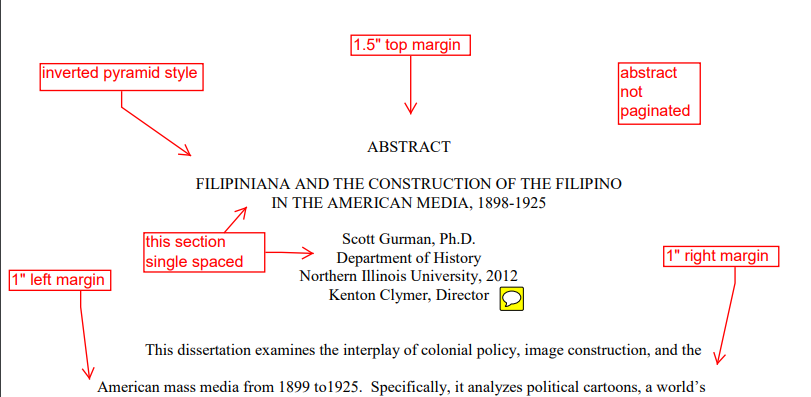

All successfully defended and submitted theses go through a revision process with this office. Why? To fix the formatting...which is explained in the guidelines. (I apologize if this is giving you flashback to "IT'S IN THE SYLLABUS"). Many students are surprised by how much more work they need to do. When they think they are completely done because they had a great dissertation defense, and then find out they have to make scores of corrections, it's kind of a buzzkill. If you've submitted your defended document on time, you will still graduate! But, the better that document looks at the time of submission, the more headache you'll save yourself. You should be planning a graduation party or looking for a job, not tweaking margins and re-labeling tables and setting fire to your laptop.

For another example, see the figure below. Figures and tables are labeled differently. Figures have the number and title below, while tables have them above. There are also different conventions for naming each, and their placement within the document. Did you think about that before? Some published students already know about such conventions, but many others do not. 

There is a reason that some journals look great and consistent from cover to cover. An editor followed exacting guidelines to get it that way. The Thesis Office has exacting guidelines so that NIU sends documents out into the world that represent the high quality of the graduate scholarship done here. We want you to look great, because you are great!

more guidelines...

Finally, the most common problem students come to visit us about is their page numbers. Unless you have published a book, you probably haven't had to wrangle page numbers a lot. We have a very informative video on how to do it, and the simple logic of it can save you hours. Check it out!

After seeing students' worst problems over the years, we know what needs to be clarified. Use the list of guidelines and the red-marked templates on our site, and you won't need to see so much red ink on your own document. Thanks for reading -- now go read the guidelines! 


Templates and Examples: https://www.niu.edu/grad/thesis/templates-examples.shtml

Video Tutorials: https://www.niu.edu/grad/thesis/video-tutorials.shtml

Friday, January 11, 2019

Downtime is Productive

by Robyn Byrd

As winter break approaches, folks will ask writers and researchers, "so you plan to get a lot done over vacation?" First of all, winter break is not a vacation. Second... NO.

As behind as one might be on writing a thesis or dissertation (or on any other big project), it is important to take your downtime where you can get it. Even if it means filling your schedule with other things, like a day job. Some of my colleagues spent the break doing nothing. If you can afford it, downtime doing nothing can be just what you need. But if you can't, or if you're restless, then setting aside knowledge work for a time and working on "regular people" stuff instead can be a much needed respite. In the 21st century, we now know that sometimes a break from work is the only thing that can really increase work productivity. 

It is important to affirm this to yourself, just as it important to renounce the lie that downtime is lazy. Americans, even those of us who have opted out of the rat race, are obsessed with being productive, with working ourselves every hour that's available. It doesn't actually help us get much done, and it wrecks our relationship with the intellectual work we love.

I spent my winter "break" doing seasonal work and teaching intensive ESL courses for international students. I worked seven days a week. I don't recommend it. But what didn't I do? I purposely didn't work on my dissertation. Sometimes this stressed me out, but other times it was freeing. I had license not to do schoolwork. It was winter break. Besides, I had not a single hour left in the day to do anything but "real" work. I paid off the bills, almost as if I wasn't a poverty-wages grad student. I gave my kids a middle-class Christmas. And somehow, as exhausted as I was by all this... I'm ready to start my dissertation work again.

It's okay to bench yourself.
Pushing through a winter break, or even too much of summer, by working on a thesis or dissertation is a bad idea. Think of any other craft that involves such specialized, Herculean effort. Athletes, for instance, don't train like crazy for their sport in year-round. Not until it's time. If they trained every day, they would wear themselves out, open themselves up to injury, and probably become bored. And if they're smart they don't train right up until the night before the big meet. They stop to eat, and take much needed downtime to heal. Knowledge workers, mental athletes, need to allow ourselves the room to heal, to prepare, and to let downtime make us yearn for our work.

This analogy applies to musicians as well. My partner's band goes on hiatus every winter after a December Christmas show. They play hard through the summer and into the holiday season, so they know they'll burn out if they play through the year's end. In spring, someone will get a gig again. They make a plan to have one by March. And then they rest. It is then that new ideas for songs come, tunes heard on the radio remind them of what they love about music, and soon enough they are back at it, ready to rock.

It's important to note that even though I worked my butt off at not writing this winter, I didn't do it without a plan to come back. The semester system gives an unstructured person like me just the calendar I need to plan my work. Next week the university starts up again. Winter break officially ends. I will officially quit my seasonal job, and I will set to work on my dissertation, yet once more. You see, while downtime is very important, you have to set a limit on it. A couple of months was just right for me. Just enough to get lost in this different life of being a working person. After my time away, physically and mentally, I'm ready to strain my brain instead of my back.

Friday, August 10, 2018

Hello From Your New Blogger and Fellow Dissertator!

by Tiffany Messick
Tiffany at work
I’m a transplant from Austin, TX. This month I’m beginning my fifth year as a PhD student in the English Department. I put my committee together in February and recently defended my proposal at the end of June. I’m currently half way through a first draft of my first chapter. I’ve taught FYCOMP for four years and absolutely loved it but now I am here to help other dissertation writers make progress. I can answer big existential content questions but am also great with MS Word formatting. My concentration is 20th Century American Literature, specifically Southern authors (Walker Percy, Zora Neale Hurston, Carson McCullers, and Richard Wright). I like to complicate matters for myself by choosing topics which are interdisciplinary, which is how I landed on Cartesian dualism and the American South. I’m often in libraries or coffee shops dissertating.

Bowie at work
When I’m not twisting my brain into a pretzel, I love to watch classic movies like my favorite, A Streetcar Named Desire, and listen to music. I’m a bit of a rock music encyclopedia. Test me sometime! I have two wiener dogs, Vienna (Sausage) and Bowie, who are very cute and very spoiled. I also like to read (obviously) philosophy. Camus, Nietzsche, Sartre… are a few of my favorites. Eventually I hope to become a professor of literature at a university somewhere. I earned my Bachelor’s in English at the University of Texas. Hook ‘Em! For my MA I studied at Northwestern State University of Louisiana. I love to write and I’m sure my enthusiasm for writing will rub off on you to make the seemingly endless dissertation process easier. I’m addicted to watching history programs on PBS and National Geographic and true crime on Investigation Discovery.

The biggest struggle I’ve encountered writing the dissertation has been being away from my support group back in Texas. Graduate School, especially the dissertation process, can be very isolating. Come talk to me about any obstacles you might be facing and how to tackle them. 

Friday, May 4, 2018

Announcing: Dissertation Boot Camps

A post-traditional NIU student
*trying* to work from home
This summer, for the eighth year, the University Writing Center at NIU is offering its Dissertation Boot Camps!

These camps are retreat-style workshops, presentations, and writing sessions for those who are in progress (past prospectus defense) on a dissertation in any field. What is retreat-style? That means you the Writing Center facilitates full-day schedules (from two days to a whole week), giving you dedicated writing time with interruptions from home life and other work. We all know it can be impossible to write at home with kids, pets, and responsibilities distracting us. Or even if you write at work... there is always other work! Dissertation Boot Camp is a chance to get away from everything that's been keeping you from writing, and work on your dissertation surrounded by peers with the same lofty goal: a done dissertation.
Quiet writing time in the lab
or around campus


In addition to long blocks of dedicated writing time (approx. 5 hours per day), Gail Jacky, director of the UWC and veteran writing tutor, will lead sessions on tackling writer's block, how to relax, and other common problems. Writing coaches will be available to give formal consultations and feedback, and talks with your peers can be just as fruitful.

Intellectual isolation from our family and friends can be almost as frustrating as not being able to find time to work around family and friends... so being in a cohort of dissertation-writing peers can also potentially alleviate the stresses of compartmentalizing everyday life and feeling alone in our struggles. Even if just for a few short days.

Schedules for the programs depend on the length of the workshop: the cost of the 2-day camp is $100, and the cost of the week-long camp is $250. Some writers decide to go ALL IN and stay overnights at NIU! The Holmes Student Center offers affordable lodging on campus, if your really need to get away and focus your time on your work.

Workshops run throughout the summer. You can make this fit around your summer vacation or work responsibilities:

Writers can chat, cheerlead, or just comisserate!
2-day Bootcamps

June 13-14
July 17-18
August 1-2

Week-long Bootcamps

June 25-29
July 23-27


Learn more at the UWC website, and email Gail Jacky with any questions!


Friday, March 9, 2018

Why All These Books?: The Explosion of the Dissertation Self-Help Market

Let's talk about Self-Help books. And let's face it -- most are bad. But some, the practical ones, or maybe the ones that use a metaphor that just sweeps you off your feet, can be good, if used wisely, and taken with several grains of salt.

What's Wrong with Self-Help?
Historically, categories of self-help fall into a few repeating areas: Success, Health, Optimism. Think of the "How to be Rich" books, or "How to Get Friends" books. You've seen them or heard of them, maybe even taken a peek inside? And the health books? WOW. There is a whole section for those in the bookstore.

In the 1970s, as America moved forward from the Civil Rights Movement, and then Vietnam, the feelgood book became more of a thing than ever. And then it became a huge publishing industry. It tapped into people's insecurities, their struggles with body image, and their dissatisfaction with life. For some, self-help really helped. For others, it left them as isolated as before, and out a few dollars...or more. I remember digging in my mom's bookshelf when I was a kid in the '80s, and finding books with titles like Real Women Send Flowers. The most striking one I remember? A slim motivational handbook entitled F*** Yes! My mother grew stronger and stronger as we grew up, but I don't think it was because she spent $10 on F*** Yes!

In the 1990s, the pitfalls of self-help were becoming evident. The market was flooded with The Art of the Deal, 10 Days to Self-Esteem, and other well known but probably useless books. Counselors, psychologists, and other began to notice that self-help was replacing folk wisdom, making people actually feel more helpless, making them blame outside things for their own failures, and offering glib and disingenuous advice (especially the success books). In 1993, Wendy Kaminer published I'm Dysfunctional, You're Dysfunctional, an intelligent indictment of the entire self-help philosophy, and she marked the decline of the decades-long fad as the 21st century approached.

Though the industry of self-help did not collapse, it has been replaced in part by self-care methods like meditation, one-on-one counseling (owing to reduced stigma), and time honored traditions like group yoga. We are not afraid to let others help us anymore. So no need to read about it in private!


The Dissertation Self-Help Book

So where has the self-help book found a new lease on life? In the form of the dissertation self-help book.

Don't jump!!!
The dissertation self-help book has exploded over the last twenty years or so. Familiar metaphors from 20th century self-help, such as survival, demystification, baby-steps, a journey, grace the covers of these books. Familiar models of coping and solution fill their insides: 12-step programs, "invisible rules" that just need to be uncovered, methods to diminish the importance of the problem (I have a book called It's *JUST* a Dissertation!), romanticization of the reader's situation and magical thinking.

It's true that there are helpful pieces of advice in these books. But oh dear, the metaphors... Can we stop talking about the dissertation as if it's not a real thing?

Well... for some of us the dissertation takes a million years to write, so it really does feel like a journey. Or like any number of the romantic and fearsome metaphors on those book covers! But there is a real problem with the self-help model: It focuses on recovery. Any recovery approach itself has problems, but to suggest that a dissertation is something that needs to be survived or overcome is to suggest that the dissertation is a malady or even an addiction. Ill advised it may be! But it is not an illness in need of a cure. It is a project in need of planning, management, and other practical solutions. (See "Practical Dissertation Help Books" below)

Someone needs to write the I'm Dysfunctional, You're Dysfunctional of dissertation help books. I'm Not Writing My Dissertation, You're Not Writing Your Dissertation.  It's good to have some inspirational books around. And it's helpful to envision yourself on a journey or a quest or whatever floats your boat (yet another diss metaphor...). But how do we read about dissertations with care and a critical eye?

This article on the dissertation book culture is a helpful read:

The Failure of Dissertation Advice Books: Toward Alternative Pedagogies for Doctoral Writing


Practical Dissertation Help Books

BUT WAIT! After all our nay-saying, there is hope. We do recommend some of these books to our students. And other universities do too. I'm just on about the self-help so you know there's no magic "cure" for your dissertation. But what there is are some good books with practical advice:

Writing the Doctoral Dissertation: A Systematic Approach
(We recommend this to everyone!)

The Craft of Research

Proposals that Work

Here are some more books you might want to explore, curated by the University of Michigan graduate school. But don't forget your shaker of salt.

Recommended Books on Dissertation Writing

One final and important suggestion: Taking a page from this millennium's change from self-help to self-care and group help, maybe don't look for all the answers in a book? Talk to other dissertation writers often, take care of yourself and your body, and seek help from professionals if you need to. You are the first person who can help yourself write this dissertation. The words and research have to be yours, but you don't have to handle the "journey" alone.

Explore this map and other fun stuff at
https://www.academiccoachingandwriting.org/dissertation-doctor/the-dissertation-journey

Friday, November 10, 2017

The Collaborative Dissertation

Soooo many authors...
Yesterday, I completed the drudgery that is teaching undergraduates how to cite their references in APA format. As we went through all the little details, commas here, periods there, I found myself marveling at how many papers had multiple authors. I always knew this to be the case for papers in the sciences and social sciences, but as I wrote all those names and "et als" out on the board I thought, "Why are scientists expected to write their own solo dissertations? None of these people are writing alone!"

Writing the dissertation can be the loneliest time in an academic's life. In the case of the humanities, it actually does reflect much of the work we will do once we get a job someday (please, please, please...). But in the case of the hard and soft sciences, that isn't so. Researchers in the fields most often work in teams. The American Sociological Association and the American Association for the Advancement of Science both offer extensive articles and blog posts on collaborating. Everyone is doing it!

So it seems that no one person can or should handle all the moving parts of a major experiment, be it conducting gene therapy on mice, or surveying survivors of assault. Science and social science require objectivity. Placing an experimental project meant to add original material to scientific discourse -- dissertations must be original contributions -- into the hands of an amateur scientist (the doctoral student), no matter how brilliant, seems like a recipe for existential and experimental trouble. Results could be compromised and things could be overlooked or fall through the cracks, when a researcher has to plan it all, do it all, document it all, and write it all up.

More importantly, for the students' sake, placing such a weight on the individual is not indicative of, or good training for, collaborative work that they will eventually engage in. It does them a disservice to expect such a strangely isolated project of them, at a time in their lives when pressure is high, pay is low, and finishing the project is the only thing that lies between them and their career. Weathering this experience as a team, or even as a partnership, could make it far more bearable and fruitful.

Looking at tissue cultures is more
fun with friends!
This is not to say that every science dissertation writer is actually going it all alone. Certainly, collaborative research feeds into students' dissertations and into professors' papers all the time. But no one but the writer is given top billing. Usually, only one student gets the Ph.D. for that dissertation. And where does that leave the others who put long days and nights into the scientific work that created it? Should working on other students' doctoral research grant a junior grad student a master's degree? Or should senior students simply plan and execute the entire project together, as equals?

A search for collaborative dissertations comes up thin. They are catching on in education, where all kinds of collaboration are non-competitive, daily occurrences (give me that lesson plan, eh?). Collaborative dissertations are, according to a 2015 paper, a "disruption" in composition studies. This is odd considering Comp teachers are teachers too. And in the sciences, the co-authored diss is still highly uncommon. However, some researchers and universities hope to change this.

NIU Chemistry students make one of
their colleagues disappear.
In 2014, two students at Saybrook University completed an important study on diabetes -- together! -- as their dissertation.  The dual-authored document is a far better model and far better practice for writing scientific papers for publication. Charlene Conlin and Carlene Phelps offer some awesome insight into the basic requirements of doing such work as a team:

  • Mutual agreement on what the researchers intend for their dissertation, both in process and in outcome.
  • Ego minimization when necessary to achieve the greater good.
  • Organization in the form of intentions, goals, and timelines.
  • Resiliency in the form of drive to keep going until both get to the finish line. (It seems particularly important to have someone else relying on to you to get done!)

You can read the rest of their advice and more about their study here.

Why collaborative dissertations have not caught on, seventeen years into this new millennium, I can't say. We've rethought every kind of document we create, from music to film to the news. But we still think of a dissertation as a monolithic monograph and a rite of passage, rather than a learning opportunity that will prepare students, especially those in the sciences, for a long life of collaborative work and collaborative writing. Why do you think we cling so tightly to an outdated dissertation model?

For more on the future of the dissertation, keep reading!

"I'm not sticking my hands in there unless someone else does it first!"


Friday, March 10, 2017

Engaging with the Writing Process


Over the past few weeks, several advanced grad students have contacted us in the Thesis Office to check on requirements and deadlines they need to meet now that they’ve passed exams and are moving on to the thesis or dissertation.  Congratulations to all who’ve reached that point!  Heading toward completion naturally entails reengagements with the writing process, a process that involves five stages: prewriting, drafting, revising, editing, and proofreading.  Each stage deals with important but discrete sets of activities, and it’s worthwhile reviewing them.  Noting how writers move back and forth between the stages can help you set goals and prioritize tasks as you work on the different parts of your project.

Stages of the Writing Process

Prewriting:  Many activities before (and even after) you sit down with pen and paper or face keyboard and screen are parts of prewriting.  Prewriting is likely one of the longest stages of a thesis or dissertation project.  Ideas for your project likely begin to form as you take courses, complete other program requirements, and prepare for your qualifying exam(s).  For some writers, ideas have been forming over a period of many years.  As you turn to the writing project itself, prewriting involves focused idea-generating activities like listing, clustering, freewriting, and outlining.  

Drafting:  Composing with a plan.  The word plan distinguishes drafting from activities that belong to the stage before or after it.  When you’re producing text from a plan based on outlines, notes, or texts you generated while prewriting, you’re drafting.  If instead you’re staring at a blank page and don’t quite know how to move forward, you’re still in the prior stage and need to engage in prewriting activities until you can form a plan for your draft.  On the other hand, if you’ve drafted a considerable amount of planned text and feel it’s time to make changes to it, you’re progressing to the next stage.

Revising:  Literally, looking back at an accomplished draft.  But more than just looking back, revising involves rethinking and changing the “big picture” of what you’ve drafted: reorganizing sentences or paragraphs, deleting passages, or adding new content.

Editing:  Making changes to textual details.  The phrase textual details anchors the answer to the question “What’s the difference between revising and editing?”  But in truth, revising and editing often overlap.  The nature of the changes you’re making helps distinguish the two stages.  If you’re reordering sections of a draft, adding substantial amounts of text to it, or cutting out large portions, you’re still involved in revising.  If instead you’re more concerned with word choices or word forms, fact checking, and confirming that your in-text citations match your end references, you’re editing.
 
Proofreading:  The final stage.  Proof is a publishing term for a nearly-finished piece that needs final checking before going to the printer and out for public viewing.  Final checking involves careful, methodical, line-by-line reading and correcting of textual mistakes to ensure accurate punctuation, spelling, and formatting throughout the document.

Embrace Each Stage: Advice for All Seasons

As you progress through your project, a sound piece of broad advice to take on board: embrace each stage of the writing process in nearly equal measure.  Prewriting is needed to get you started in the right direction, and drafting is essential.  But revising, editing, and proofreading are also vital to a successful finished product and deserve plenty of attention and care.  If you seek help or guidance during any of these stages, but particularly with prewriting and drafting, remember that the University Writing Center is a fantastic resource.  If you have questions or concerns with revising, editing, or proofreading, be sure to contact us here in the Thesis Office.

Good luck in all stages, happy spring break, happy writing!     


Friday, November 18, 2016

Book Review: Writing the Doctoral Dissertation

At the beginning of any dissertation journey, both the journey and its destination seem hazy and amorphous. As the years of coursework rolled by, I had felt as if the diss was a huge, distant thing on the horizon that was painfully, slowly coming into view. It started to take a shape, and it became more and more real as I could see it looming there. But when I found myself close up, at the end of coursework, at the top of the field exam climb, I realized it wasn't a thing at the top of that mountain. I looked out across another chasm instead, with no clearer image of what the diss really was than before all my hard work.

Enough of that! I won't deny that this poetic sort of thinking about dissertating can be helpful, and is my usual mode as an English major. But especially as a disorganized English major, and as anyone in any discipline who has ever had trouble seeing the clear shape and scope of a project, I needed help thinking practically. I needed help making a plan. There are so many good books on the market, but many of them are titled in metaphorical language, some inspiring, some terrifying: Survival Guide! One of the books in our office has a cover image of a stormy sea with a flimsy lifesaver floating on it.  No thanks.  My dissertation is not the Titanic.

In Writing the Doctoral Dissertation: A Systematic Approach, the dissertation is not characterized as a "quest" or a "trial by fire" or anything other than what it is. It's a writing project! The book turns the diss into a procedure, like any other.  A procedure with linear steps (some cyclical ones too), with deadlines, and with clear goals. Gone are the musings about "demystifying" the "journey" or some other useless crap that a person in the throes of drafting could have thought of themselves.  If what you need is a clear, disinterested voice, untinged by commiseration or by condescension, to say to you "DO EXACTLY THIS"... then this is the book you should read.

Also, this book is fairly new, like of-this-decade new.  Its authors know about current trends in scholarship in various fields, alternative sorts of dissertations, and contemporary expectations for research in an age of globally accessible information and project collaborations.

In my youth I was always the straight-through writer, never an outliner. In grad school I began to see the purpose of having a structure and some goal-points in mind before beginning a project. But I never put that to use beyond the twenty or so pages required for my term papers.  Assorted piles of papers with color coded post-it notes were enough semi-organization to get me through. But now, as I face this new ~200 page project (journey, chasm, abyss, whatever you want to call it), this book has me obsessed with the checklist, the calendar, the breakdown, and even the "budget" of the dissertation.  In a very good way.

Writing the Doctoral Dissertation: A Systematic Approach (by Gordon B. Davis, Clyde A. Parker, and Detmar W. Straub, Barron's, 2012) is available online and in the NIU bookstore.  Here is a summary from one of the contributors:

http://www.gs.howard.edu/sbe/text/reading5.pdf

At $12.99 it will be one of your best grad school investments (or maybe a close second to the coffee pot).

Friday, November 4, 2016

The Nontraditional Dissertation and You

Opening panels of Nick Sousanis's dissertation.

By tradition, the dissertation is a text-centered project rooted in conventions established long, long ago during the early days of print. Perhaps you agree it's high time to overturn the old ways. Perhaps you're ready to see academia break free from the shackles of tradition and embrace dissertations that depart from the monograph or that combine text with images and other media.        

The Nontraditional Dissertation

Actually, contemporary dissertators have already started clearing such nontraditional paths, and coverage of these developments makes for some interesting reading. In an entry last June, our blog touched on stories of pioneers of various sorts who have approached the dissertation in novel ways; the first story is amusing but also alarming (detailing how politicians and other officials in Russia have been buying dissertations on the black market!), whereas the second is intriguing and rather inspiring (documenting dissertations that take the form of interactive digital texts or even comic books). The advent of the comic-book dissertation was further detailed (with plenty of eye-catching graphics) in this 2014 article by Sydni Dunn at The Chronicle of Higher Education. Dunn devotes much of her piece to Nick Sousanis’s Unflattening, a dissertation in comic form that Sousanis produced at Columbia University and subsequently turned into a book, published in 2015 by Harvard University Press. Sousanis is now a professor at San Francisco State; you can read more about his work on comics as educational tools on his detailed website. Finally, you can find an abundance of relevant articles and media clips on the website of the #Alt-Academy, a place for humanities scholars to share their experiences at producing unorthodox dissertations and embarking on nontraditional academic careers.

Where Do You Fit In? 

Regardless of your field, you may wish to pursue a nontraditional dissertation. When I initially heard that term, the first thing that came to my mind was some kind of creative piece that involves more than just written text, something like Sousanis’s comic-book dissertation or a performance-based project one might produce in fields such as dance, theater, or film. But there is certainly room for nontraditional approaches in other fields such as education, engineering, or health and human sciences. In fields like these, research and post-degree goals may fit in nicely with a project comprised of stand-alone articles, reports, or digital materials (instead of a unified set of dissertation chapters).

If you're contemplating a nontraditional route for your dissertation (or thesis), here are three main points to consider as you make your plans.

1. Acceptability. How enthusiastically will your committee members accept the idea? You obviously need to get approval from your director and other readers as you prepare your project's proposal. At this stage, you'll most certainly need to inform them of any plans you may have for out-of-the ordinary methods or innovative presentations of results.

2. Marketability. How will a nontraditional project enhance your short-term and long-range career prospects? 

3. Flexibility. How willing and able are you to make changes to your nontraditional document, your methods of displaying it, or to the way it mixes textual innovations with conventional formatting requirements? Note that certain features in complex multimodal files may not display effectively on platforms like ProQuest (or the file may exceed the size limit).   

And, by the way, if you're already working on a nontraditional project (or if you've completed one), we'd be thrilled if you told us a little about your experiences in the comments section below!

Nontraditional in Form: Your ETD 

Of course, compared to a traditional dissertation or thesis from the distant or even more recent past, the document you eventually complete will be inherently nontraditional: no matter how conventional or non-digital it is in execution (whether you develop it from handwritten drafts, lab experiments, fieldwork, studio sessions, or performances), you must convert the report of your defended piece (conventional, innovative, or somewhere in between) into a PDF file that can be read and distributed electronically. Remember that we provide step-by-step guidelines for submitting your file as an electronic thesis/dissertation (ETD) on our webpage. Good luck with all your work as you progress to that final stage!

Wednesday, October 26, 2016

Building Your Tribe (Again and Again)


If you're an average-aged grad student or older, you're a full fledged grown-up by now, whether you like it or not. Like me, you've probably realized that making friends as an adult is not like making friends as a young person. When we lose the easy friendships of our high school tribe, our college tribe, or even our bar-going, concert-going, or [insert any 20-something activity here] buddies, the road to a graduate degree can get lonesome. The sobriety of adulthood and of the graduate journey are two strikes against us as friend material.

What I've realized is that adults, especially in our line of work, need friends with common interests and similar goals. The exuberance of youthful friendships and the energy of their bodies and minds (and their staggering amount of free time) makes friendships of all kinds enjoyable and sustainable.  We can still have our old friendships. But as graduate students, we have a specific goal shared by a small percentage of the population. Not only that, our most passionate interests are only interesting to an even smaller, infinitesimal percentage of the population. It seems like we need to bust out the Venn Diagrams to figure out which of the people we know should still put up with us as friends!

The First Tribe: Get One!

When I say we need similar people in our lives, I don't mean vaguely similar. Like "We are both success oriented and outgoing!" similar. I mean SIMILAR. Like, "We both study the genome of a rare species of Bolivian rat!" similar. ...I'm kidding. But students in your department who share the same journey are the first place to look for camaraderie, if you are newly doing the grad thing. Attend lectures, talk to people after class, join a group, go out for drinks. At first it will be awkward. But we're all old enough not to care about being "cool"! So try really hard just to soak it all up. Be observant, and don't be competitive.  You are all in the same leaky boat.

In the English Department at NIU, we had a broad core of classes, no matter our focus, and I met many like-minded people. Among the TAs in particular, our shared experience of teaching composition to freshmen created a strong bond. (Working on campus and being a part of the department is priceless.) The coursework experience, and the combined experience of the first few years of teaching with people I also studied with, won me a new tribe. I can only hope that coursework and GA work is such a social boon for all early career grad students.

End of Coursework, End of Social Life?

That tribe disappears, all too soon. The MA students were gone in two years. I miss some of them a lot. PhD students who entered ahead of me, core members of my tribe, are off dissertating, locked away from social interruptions. Some have finished and moved far away.  I stopped driving to campus for the drink nights that used to be so easy to attend when they were right after class. Today, I have the solid support of my office, and the vague support of my family who have no idea what I'm doing. But I haven't much in the way of comrades. I feel like I'm writing all alone.

All I can say is don't let that happen. The involvement will diminish, but the time spent together is still important. At the stage of the thesis or dissertation we need so much more than commiseration and shop talk. We need support, strategies, hope, and human connection. We spend so much time with our research and our laptops. It's odd, really. But you know who won't think it's odd? The other people who do it.

Facebook groups (friend everyone!) are a great way to plan events and stay in touch, even when you hardly see each other in person anymore. Part of the reason I dropped out of the tribe was lack of transportation.  Well, I've got a new car! Writing this post has given me the urge to get back on social media and find some real-life social activities to do.

Other Ways to Connect

I know I just said you need grad student friends. But there are other kinds of specifically like-minded friends! That's my main thesis here --  we are not the best friend material right now.  So we should seek friendship that is as supportive as possible of our unique situations.

I have a social life outside of school, almost solely because I'm in rock bands. This is another way that I surround myself with people of very specific interests. Do you play? If not, you're probably not someone I see very often. It sounds bad, but we only have so much time, and we need to fill it with the right kinds of stimulation.  So in addition to your efforts on campus, finding a hobby and focusing on it can round out your social life better than aimless bar-going or online dating. Most of us can't turn our brains off, right?  So find something that stimulates a different part of it.  Art, geo-caching, gaming, hiking, whatever. A specific thing to share.

Someday We'll Be Normal (Sort of)

Someday we will finish our theses and dissertations. We can nurse neglected friendships, balance our lives out, and maybe even start eating real food again! I'm not arguing at all that high-achievers have no use for broader social circles and diversity among their friends. I'm just saying that right now, you need grad school friends. And the best way to find the ones who will help you along your journey is to simply look around at your fellow travelers.


Friday, October 7, 2016

The Thesis and the Dissertation: Peas in a Pod


We call the document for the master’s degree a “thesis,” and the longer one for the doctorate a “dissertation,” and perhaps you wonder why.

Well, many thoughts on the nature of theses and dissertations have been buzzing through our office lately. Over the past four weeks, we held our fall slate of presentations, workshops, and brown-bag sessions for students working on one or the other kind of document. Several of our programs cover important details behind the Graduate School’s document-formatting requirements. When we look through these requirements closely, it becomes clear that they’re nearly identical for either a thesis or dissertation.

So, then, if the format looks nearly identical, what distinguishes the thesis from the dissertation? A glance at the histories of the two words makes for an interesting way to highlight some differences and similarities between these two important writing projects.

"How do I put it?"

Thesis writers, do you sometimes find yourself wondering how to put your ideas in writing while working on your project? If so, you're not only human (nearly all writers, at some point, wrestle with how to put thoughts on paper or screen) but also hinting at some of the history behind the word "thesis." Like many terms in academia, the words “thesis” and “dissertation” come to us from Greek through Latin. "Thesis" originally derives from the Indo-European root *dhe-, which had the meaning of ‘to set’ or ‘to put.’ The root later formed the central element in the Greek verb tithenai, meaning ‘to place, put, or set,’ as well as the noun thesis. In Latin, thesis referred to the unstressed and later the stressed syllables in a line of poetry. (Stress for thesis writers today is usually of a different nature!) In the English of the late 1500s, “thesis” began to refer to a statement to be proved through logic—in other words, a thesis statement. By the next century, the word’s meaning broadened to include what we in the twenty-first century think of when we speak of a master’s thesis--the formal document presented for the master’s degree.


Scholars at a lecture. Engraving by William Hogarth, 1736
"Contrary to what others have said, I argue that…"

Dissertators, when you explain your project, do you sometimes linger around that point where you need to arrange your thoughts to emphasize how your work stands apart from previous scholarship? Such efforts invoke something of the original spirit of the word "dissertation." It's rooted in the Latin verbs dissertare ‘to debate, argue, examine, harangue’ and disserere, a combination of dis- ‘apart’ and serere ‘to arrange.’ The etymology zeroes in on the general task doctoral candidates must carry out today: arrange an argument based on original evidence as well as on an examination of the surrounding scholarly debate, write it out clearly and convincingly at length, share it with the world, and live to tell about it. (Long sentence, longer ordeal!) The word began to refer to such a thing in the 1650s, around the same time "thesis" began to refer to a similar piece. According to the OED, the meaning of "dissertation" began to be restricted to the monograph produced for the doctorate in the 1930s.

Peas in a Pod

Thus, once established in academic circles, the terms "thesis" and "dissertation,” along with the documents they refer to, grew up alongside each other. No wonder, then, that their format requirements overlap and that we sometimes speak of these two types of documents in the same breath. But in addition to the etymological and historical hints at what these documents do, universities usually separate the two by degree and kind. The thesis is shorter and is a kind of knowledge display. The dissertation is longer and is a kind of original research and significant new contribution to a field.

Of course, the Graduate School also offers clear and succinct definitions for a thesis and a dissertation. Check them early and often. And you can always turn to us if you seek further information or guidance. We’re happy to help!

In case you missed one of our fall programs, note that we’ll be offering presentations, workshops, and brown bags once again at the start of the spring semester. In the meantime, we’re available through email, phone, or walk-in. And remember that our writing group for thesis and dissertation writers, Write Place/Write Time, meets on the second Thursday of every month from 6 to 9 p.m. in Founders Memorial Library (4th Floor East). Look for us there this coming Thursday, October 13. Happy writing!   

Source for the above images: Wikimedia Commons.

Friday, September 9, 2016

The Right Place to Write?

Mark Twain finishing a chapter?

NIU’s thesis and dissertation writing group, Write Place/Write Time, met yesterday from 6 to 9 p.m. for our first fall meet-up. Four of us convened in our clean, well-lighted place—reserved every second Thursday—next to the Fourth Floor East windows in Founders Memorial Library. After greeting and chatting briefly, we each got down to business: composing in a quiet environment largely removed from everyday distractions. A great experience!

Writing alongside others working on projects similar to your own has many benefits: structure, support, accountability, and a spirit of healthy competition (in the positive sense suggested by the Latin roots of compete: com- ‘together’ + petere ‘to strive’). In previous posts, this blog has featured excellent overviews of Write Place/Write Time and its benefits in the context of one dissertator's routine and schedule (May 20, 2016, and December 4, 2015). Here I’d like to add a bit more on the topic of the places where successful writing happens through sharing of a few pieces of literary trivia.

Other Writers, Other Places

Virginia Woolf once famously said, to be able to write one needs money and a room of one’s own (in reference to women writing fiction in Shakespeare’s day). As any grad student can tell you, she was right about the money part.  But what about that other part? Is a room of one’s own the optimal setting for good writing?

Georges Simenon--
I think he's the guy at the desk.

Settings you can’t call your own may very well feature all manner of unhelpful distractions. Perhaps that’s why Belgian novelist Georges Simenon strongly favored working in a room just for him. Creator of hundreds of detective novels, Simenon was “perhaps the most widely published author of the 20th century,” according to his official website. Simenon would reportedly complete a novel in about eleven days of isolated, non-stop writing. He would take breaks to eat and sleep, but during these writing stints he would speak to no one, take no phone calls, and never leave his room (Salgado 66). No word on whether he ever considered grad school.

Writing in your own space may help foster constructive writing methods. In his later years, as pictured above, Mark Twain apparently preferred to write in his bedroom while still in bed. Twain isn’t the only successful author who developed a fancy for horizontal composing. The approach has been taken up more recently by DeKalb High School graduate, novelist, and Stanford professor Richard Powers.

Richard Powers: Standing up at Stanford.
In a 2003 interview in The Paris Review, Powers related that his dream “has always been to suspend myself in space when I write, and lying horizontal in bed is the closest to doing that.” Perhaps this method is worth exploring.

Just as memorable and worth considering is Ernest Hemingway’s habit of writing in his bedroom while standing up. A fascinating portrait of Hemingway’s work habits appears in this 1958 interview in The Paris Review.


Summing Up: Write Place/Write Time

Ernest Hemingway thinking on his feet.

Certainly all writers need some sort of combination of place and time in order to get their writing done. May the above anecdotes and reading links refresh some of your ideas about writing, help you rethink places where your best writing happens, and inspire you to get back to it.

And remember: a room of our own is available every second Thursday in the library. We hope to see you there. Until then, happy writing!


                             Work Cited
Salgado, Gamini.  “The Novelist at Work.”  Novels and Novelists: A Guide to the World of Fiction.   Ed. Martin Seymour-Smith.  New York: St. Martin’s, 1980.  Print.


Friday, August 26, 2016

The History of the Dissertation in Academia


Since I am in the beginning stages of writing a dissertation, I began to wonder... WHY???  And I'm sure you all wonder this at some point.  I looked into the history of the dissertation and didn't find much of interest, until I came upon an old, stale article (does anybody remember 1998?) by Gary Olson and Julie Drew.  It's an interesting read, despite its staleness -- because of its mission.  The authors' need to go into the history of the dissertation is driven by their urge to protect the scholarly and professional status of the dissertation -- to keep universities and faculty alike from downgrading these documents, which are no longer necessarily published or even publishable, to grey literature, second-rate student exercises in a discipline. If that's all it is, then why do it, right?  Academia is so bad we might as well all go ABD!

The History

But wait -- we are working in an enterprise with a short but significant life.  Here is a brief look:


The dissertation is a relatively new rite of passage in the history of academia. When medieval and Renaissance scholars took academic titles, they didn't dissertate to get there. And when some of the most highly educated scholars and writers of the Early Modern Period finished their schooling, they didn't take the title "Doctor". (Unless maybe they were a Doctor of Physick and liked attaching leeches to people!)

The dissertation has its origins in 18th and 19th century Europe, particularly in Germany. Herr Doktors were the first scholars to have to not only write but publish a dissertation in order to have their degree conferred. This guaranteed that the junior scholars, in whom the senior scholars had invested so much time, would produce new knowledge, a contribution. The first American University to grant PhD's followed this format, and by 1861 our own Yale had produced the first three American Doctors of Philosophy, who had all published short but sweet dissertations (Olson 57). (One was six pages long!)

James Morris Whiton,
first American Ph.D.
It was this migration of the dissertation to America, combined with what one of my professors calls "the reading machine" (i.e. capitalism-fueled publishing and the consumption of such), that led to the establishment of the university press (Olson 58).  We had to find a way to print all those books!

Then, with PhDs increasing every year, it eventually became impractical to publish the "diss," (that's what we call it in the biz...), and the requirement to publish fell off by the 1930s (Olson 58).  Since then, we have moved to microfilm, a single bound copy in the library, and eventually, all electronic dissertations that have probably never been printed on paper in their final form. (Unless the proud new Doctor pays about fifty bucks to get a vanity-bound personal copy).  So, what was once a scholar's first real book, a first real contribution to the field, became more like a hoop to jump through.  A big, flaming hoop.

What do we do?

So how do we reclaim our diss? How do we make the diss a scholarly foray into a real academic conversation, rather than a closed-course driving test? Is it about attitude?  Maybe it's about our advisors and their attitude toward the project (Olson suggests as much). Maybe the answer is to think of the diss as something in between a first solo flight and a final flight simulation test. But the difference between those things is huge. The difference between those things can cost us a job. How do we describe our flying to a potential employer, if we don't even believe that we've ever really left the ground?

Well, I don't really know yet. I'll tell you when I figure it out. But no matter how I feel about the result, you can bet I'm going to order one of those fifty dollar cloth-bound copies for my tiny office.

Work Cited

Olson, Gary A., and Julie Drew. "(Re) Reeinvisioning Dissertation in English Studies." College English, 61.1 (1998): 56-66.

Friday, July 15, 2016

Re-reading Your Dissertation

I read my primary texts; I collected and annotated my secondary sources; I composed an outline; I reflected on my subject matter; I procrastinated; I became frustrated with myself for procrastinating, which only bred more procrastination; I wrote my dissertation one chapter at a time; I met with my committee to discuss my chapters; I grew frustrated and despondent after meeting with my committee, which contributed to additional procrastination; I reflected on my own academic abilities to finish my dissertation (a.k.a procrastination); I revised my chapters, again and again and again; finally, I heard the following magic words: This work is defensible.

It has been a long journey, and it has been tiring. My graduate school experience started out as a part-time experiment: I took two evening classes, spent my days reading my homework assignments out loud to my kids while coaxing them to take a nap, sat in the basement and wrote papers late into the wee hours of the night, and somehow managed to eke out passing grades. The next thing I knew I was a full-time student, teaching the occasional undergraduate class, and padding my resume with conference presentations. Now, as I approach the finish line, I recall one last piece of advice, previously alluded to in an earlier blog post: Re-read your dissertation before your defense.

Your response may be, "What? Why? Don't be silly. I've been writing the thing long enough that I know it backwards and forwards."

You may know your thesis and your supporting arguments like the back of your hand, but that does not mean that you have perfect recall of the contents. During the defense, you will be asked for specific page references concerning such-and-such argument or some secondary source. Why did you decide not to include some specific piece of research? a committee member may ask. If your response is, "But I did," then they will want to know precisely where it is cited in the body of your work. The thing that most worries me is a committee member reading aloud a passage from my text and I have no memory of writing those words. In fact, while I have been revising my dissertation, I stumbled across passages that I do not even remember writing - most likely, because I wrote the chapter long ago.

Once your committee has made the decision that your thesis or dissertation is ready to be defended, you will be expected to put together some sort of presentation -- Speak to your committee and/or members of your department about what all is involved in such a presentation as requirements may differ from department to department. While you are putting together this presentation, my advice is: re-read your thesis or dissertation. You are not proofreading the work one last time, therefore do not read it as though you are the author. Read it as though you are the target audience; read it with fresh eyes; read it in order to familiarize yourself with the content; read it as you would a piece of secondary research that contributes to your field of expertise; read it one last time as you make marginalia that will help you prepare for the defense.

When you are done re-reading it, give yourself a pat on the back. After all, you wrote it. That was the hardest part.

Friday, July 1, 2016

Have You Seen Lynda?


Image result for free image for lynda.com , that is!


*As of last November, NIU provides all students, staff, and faculty with this service. You can read DoIT’s introductory write up here.
 
Today’s blog post intends to “introduce” you to Lynda.com, in case you haven’t tried this tool.

Basically, Lynda.com is pretty cool. Here’s how it works.

You log in with your student or employee ID and its corresponding password. You get to Lynda.com either through NIU’s A-Z link or by typing http://go.niu.edu/lynda in your browser’s address bar.

This site contains many video tutorials. Most are mini-courses, taking an hour to several hours to complete, but each course is broken up into minutes-sized segments. You do not need to view an entire course. Each course includes a transcript and exercise files, should you wish to practice a specific task. And Lynda.com keeps track of your viewing history and place.

I suggest that you start by hovering over the library button on the top banner next to the Lynda.com name, and browse the larger categories of Business, Design, Education and Elearning, Photography, Video, Web, etc. Each of these categories breaks down into specific topics and applicable software tutorials. If you click on the library button, you will get an A – Z listing of the larger categories’ subtopics and the number of tutorials available for each.

Within the subtopics, you can select specific applicable software tutorials or a specific author to see all of his/her videos. You also choose a skill level from Beginner, Intermediate, Advanced, and Appropriate for all.

How can Lynda.com help with a thesis or dissertation?

Well, it can’t—not directly. However, most of us are preparing our documents in Word. 
The Thesis Office receives a lot of formatting questions for Word, but we find that students have different versions of Word running through different operating systems on computers that are purchased from all over the world; these often have unusual default settings. Add Word’s styles and hidden formatting into that mix, and sometimes, it’s hard to untangle what is going on in a document.

Also, Lynda.com is available twenty-four hours; while we try to respond to any inquiry quickly, we can’t always help you right when you’d like. 

So we want to direct you to the 59 Word Processing courses containing 2647 video tutorials on Lynda.com.  

Don’t be overwhelmed with those numbers; you can search for specific tutorials on any issue. For instance, I searched: “inserting page breaks in Word 2013,” and though I received two thousand results, I could see quickly that the top five were most applicable. You may want to look through some of the various courses’ tables of contents just to get ideas about how to phrase your searches too.

There is more to Lynda.com; I’ve only begun to explore the site. Our office will provide you with updates as we discover any helpful tips.

Have fun exploring Lynda.com, and feel free to post a reply on this blog post or on Facebook if you have found or find anything helpful there.We'd love to hear from you.