Showing posts with label NIU thesis office. Show all posts

Friday, May 3, 2019

It's in the Guidelines, Part 2: "Use them, or you'll do it wrong."

by Robyn Byrd


In last month's "It's in the Guidelines," Tiffany explained how to access our many resources on the Thesis Office website. Knowing where to look up formatting help will save you a lot of time. Now, I want to add to her post in order to stress the importance of actually using these guidelines. That is, the guidelines not just there for you to look at them if you feel like it. They're there because you NEED to look at them. In the words of one of our Thesis Office mottos, "If you don't use the guidelines, you'll do it wrong."

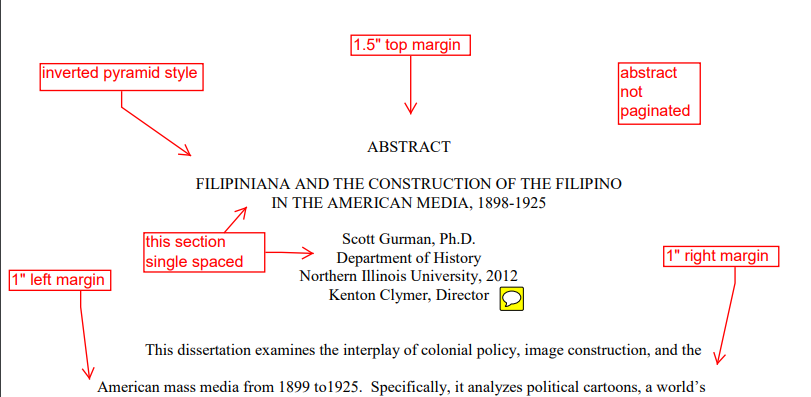
For instance, you'll start off on the wrong foot from the get-go if you don't look at the abstract and title page templates. How in the world would you figure these things out by guessing? You wouldn't!


All successfully defended and submitted theses go through a revision process with this office. Why? To fix the formatting...which is explained in the guidelines. (I apologize if this is giving you flashback to "IT'S IN THE SYLLABUS"). Many students are surprised by how much more work they need to do. When they think they are completely done because they had a great dissertation defense, and then find out they have to make scores of corrections, it's kind of a buzzkill. If you've submitted your defended document on time, you will still graduate! But, the better that document looks at the time of submission, the more headache you'll save yourself. You should be planning a graduation party or looking for a job, not tweaking margins and re-labeling tables and setting fire to your laptop.

For another example, see the figure below. Figures and tables are labeled differently. Figures have the number and title below, while tables have them above. There are also different conventions for naming each, and their placement within the document. Did you think about that before? Some published students already know about such conventions, but many others do not. 

There is a reason that some journals look great and consistent from cover to cover. An editor followed exacting guidelines to get it that way. The Thesis Office has exacting guidelines so that NIU sends documents out into the world that represent the high quality of the graduate scholarship done here. We want you to look great, because you are great!

more guidelines...

Finally, the most common problem students come to visit us about is their page numbers. Unless you have published a book, you probably haven't had to wrangle page numbers a lot. We have a very informative video on how to do it, and the simple logic of it can save you hours. Check it out!

After seeing students' worst problems over the years, we know what needs to be clarified. Use the list of guidelines and the red-marked templates on our site, and you won't need to see so much red ink on your own document. Thanks for reading -- now go read the guidelines! 


Templates and Examples: https://www.niu.edu/grad/thesis/templates-examples.shtml

Video Tutorials: https://www.niu.edu/grad/thesis/video-tutorials.shtml

Friday, February 9, 2018

Spring 2018 Programs at the Thesis Office

We are excited to announce a new season of workshops and presentations at the NIU Thesis Office! Each semester we offer programs to help you with everything from proposal development to final editing, and everything in between. Check out our current offerings...

Informative Presentations
We offer several presentations geared to specific audiences, and also a submission process presentation that is essential for ANY student who is nearing completion of their thesis or dissertation.

Saturday, Feb 17:  Writing a Dissertation in Education
Designed for students enrolled in 799 in the College of Education or similar program. We will walk you through general dissertation requirements, discuss frequent dissertation issues in Education and Public Service, and we will have plenty of time for discussion and Q&A. This class meets 9am to 2pm in Naperville for the convenience of working teachers and administrators.

Tuesday, Feb 20: Thesis Essentials (For master's thesis writers)
This is the "411" presentation on getting a thesis done. Whether you don't know where to begin, or you are planning your defense, there is probably a thing or two you don't know about how the Graduate School handles theses. This is not a writer's workshop, but a nuts and bolts, project management approach to ensuring you check off all the boxes. We will meet in Adams Hall room 103, and we will have plenty of time for Q&A.

Wednesday, Feb 21: Dissertation Essentials (for dissertation writers at ANY stage!)
This is the "411" presentation on getting a dissertation done.  This is not a writer's workshop, but a nuts and bolts, project management approach to ensuring you check off all the boxes.  You can attend this session in ANY stage of the dissertation writing process! We will meet in Adams Hall room 103 at 2pm, and we will have plenty of time for Q&A.

Tuesday, Feb 27: Writing a Thesis in Engineering
This presentation covers the ins and outs of the very specific task that is the engineering thesis. ASME documentation as well as general thesis guidelines will be covered. We will meet in Adams Hall room 103 at 2pm, and we will have plenty of time for Q&A.

Wednesday, Feb 28: Demystifying the Submission Process
Carolyn Law, director of the Thesis Office and the arbiter of thesis readiness, will demystify the secrets and confusion surrounding the thesis and dissertation submission process! Pull back the curtain and prepare to become prepared. This special session meets in Wirtz Hall room 104, from 5-7pm.

Hands-On Workshops
Each semester we offer a workshop or two based on the needs of thesis writers. This term, it's the return of the infamous "T/F/P" workshop as we like to call it.

Tables, Figures, Pagination
Come get one-on-one help with wrangling those documents! There will be some instruction and presentation at this workshop, and you will also have ample time to work on your thesis with the help of staff members and peers. Common problems like disappearing page numbers, messy figures and tables, staying within margins, and other issues will be fought and conquered!

Informal Brown Bags
Since we don't want to do all the talking (we're here to help YOU), we host several informal Brown Bag sessions each semester. These are a great way to meet other people who are on this unique journey and facing our unique struggles. Come tell us what you're on about! (And what you'd like us to help with more.)

March 7 Writing the Proposal
Bring your lunch and talk with us about your proposal ideas and frustrations! This session will be hosted by Robyn Byrd, doctoral candidate in English literature, who defended her dissertation proposal this last October. So she knows the process and remembers the ABD journey!

March 21 Breaking through Writer's Block (and other obstacles)
Join us with your brown bag (or styrofoam container) to discuss the many kinds of writer's obstacles we all face, and some possible solutions. Hosted by Carolyn Law, professional editor and Thesis Office director, who knows the fear of the blank page!

Meet-Ups for Writers
Finally, don't forget, we have a writer's meet-up we call "Write Place, Write Time,"on the second Thursday of every month. This three hour block is a stellar opportunity to make an unbreakable date with your self.  We reserve the doctoral study room on the fourth floor of Founders, and we work quietly together. There is no agenda at Write Place, except to write.  Our next meeting is on March 8.

We hope you join us for one or more of these events this season! Find them all on the University events calendar, or on our Workshops page


Friday, October 13, 2017

Video Tutorials Are Here!

You'll find a new page at our Thesis and Dissertation Office website: Video Tutorials!  Robyn and Fred spent the summer designing step-by-step guides to some of the most frequently used Microsoft Word tools for theses. Here, you'll find videos on:
  • Page Numbering: Proper pagination (creating page numbers and hiding page numbers) in your document
  • Leader Dots: Creating rows of leader dots (......) to build a professional-looking Table of Contents and other tables
  • COMING SOON, Landscape Pages: Working with landscape pages to accommodate your tables and figures

Don't get as frustrated as Fred! Watch our videos!
We use on-screen help plus live video of real people (us!) to guide you through every step of these processes. Watch the videos at full speed, slow them down, or watch as many times as you need to in order to learn the processes. Also, we have carefully captioned each one so you can watch without sound. We chose the videos we made based on what we've seen come through the office -- page numbers out of control, margins obliterated by big tables, and Tables of Contents with MS Word weirdness everywhere. When we see these problems, we sometimes have to tell a student the last thing he wants to hear: "We need to start from scratch." With these videos, we're trying to nip bad formatting in the bud. 

Fred's award for his blockbuster,
"Page Numbering"
We try to have a sense of humor to help lighten up what can be a boring and lengthy process. We don't love formatting either, but we'll help you learn to like it just a little better!  As one of our recent graduates said after spending weeks formatting his dissertation, "I should get a degree just for that!"

So before you throw the laptop out the window, avail yourself of these new videos. And if that doesn't work... come see us! We'll be glad to help in person, too. (No autographs, please.)


Friday, September 1, 2017

Announcing Our Fall Programs

Adams Hall, home of the Graduate School
and the Thesis and Dissertation Office.
Welcome to fall 2017!  In September and October the Thesis Office will once again offer brown bag sessions, presentations, and workshops for NIU grad students at various stages of the thesis or dissertation process. Some brown bag sessions are also open to faculty, and one is geared for faculty and staff.  We look forward to seeing you!

Basics
Brown bags will start in the second week of September and meet Wednesdays from 12 to 1 p.m. in Adams Hall, Room 103.  Presentations and workshops will start in the last week of September, and most will will be held from 2 to 4 p.m. in the same Adams Hall location on a Monday, Tuesday, or Thursday.  Note that two presentations meet at different times, locations, and/or days.  For details on each program, see below.  

Registration
No registration required for brown bags.  Registration is required for a presentation or workshop.  Register via email at thesis@niu.edu.  Include the name of the presentation or workshop you want to attend in the subject line or message.  We do have space limitations for events in Adams 103 (12 seats maximum).  Register early!

What to Expect
Plenty of important information regarding completion of your graduate degree.  After running these programs over several semesters, we’ve learned that most students who attend presentations and workshops are blown away by how much they didn’t fully know about meeting various deadlines, submitting the proper paperwork to the proper place, or formatting the long document.  At all our events, expect thorough coverage of common concerns as well as time to address individual questions.

Brown Bag Sessions 
Breaking Through Writer’s Block (and Other Obstacles)
Wednesday, September 13 (12 to 1 p.m. in Adams Hall, Room 103)
Informal discussion on common obstacles that slow or entirely halt progress on one’s thesis or dissertation.  Carolyn Law, Thesis/Dissertation Advisor, will facilitate the discussion and offer practical strategies.  Students only, please.

Committee Relations
Wednesday, September 20 (12 to 1 p.m. in Adams Hall, Room 103)
Informal discussion on choosing committee members, creating productive working relationships with them, maintaining good communications, and managing feedback throughout the process.  Graduate School policies regarding committees will be reviewed.  Faculty and students welcome.

Robyn Byrd leading a brown bag discussion
in Adams 103.
Writing the Proposal
Wednesday, September 27 (12 to 1 p.m. in Adams Hall,
Room 103)
Discussion will address typical characteristics of any strong thesis or dissertation proposal (sometimes called a prospectus) as well as aspects unique to proposals in various disciplines.  Faculty and students welcome.

The Balancing Act: A Life in Grad School
Wednesday, October 4 (12 to 1 p.m. in Adams Hall,
Room 103)
Informal discussion on the complexities of managing life as a graduate student, balancing family responsibilities, personal health, outside work, and the pressures of a dissertation or thesis.  Session will be facilitated by Thesis Office GA Robyn Byrd, doctoral candidate and mother of two.  Students only, please.

Faculty Q & A
Wednesday, October 11 (12 to 1 p.m. in Adams Hall, Room 103)
(Grad students, you might want to bring this one to the attention of your director or other faculty members in your department.)  Carolyn Law, Thesis/Dissertation Advisor, will introduce the functions and services of the Thesis Office and answer questions about Graduate School requirements and standards for theses and dissertations.  Faculty who are directing a thesis or dissertation at NIU for the first time are especially encouraged to attend, but all faculty and staff are welcome.

Presentations
Carolyn Law presenting on the submission process in Wirtz Hall.
Demystifying the Submission Process
Tuesday, September 26 (5 to 7 p.m. in Wirtz Hall, Room 104)
This presentation is for students preparing to submit a thesis or dissertation to the Graduate School for December 2017 graduation.  Carolyn Law, Thesis/Dissertation Advisor, will walk students through the steps of the process: defense, electronic submission, and final approval.

Dissertation Essentials
Monday, October 2 (2 to 4 p.m. in Adams Hall, Room 103)
Designed for all doctoral students enrolled in 799 in any department.  Staff will walk students through the Graduate School’s specific requirements for dissertations and cover a wide range of the most troublesome issues dissertation writers frequently encounter.

Thesis Essentials
Tuesday, October 3 (2 to 4 p.m. in Adams Hall, Room 103)
Designed for all master’s students enrolled in 699 in any department.  Staff will walk students through the Graduate School’s specific requirements for theses and cover a wide range of the most troublesome issues thesis writers frequently encounter.

Writing a Thesis in Engineering
Thursday, October 5 (2 to 4 p.m. in Adams Hall, Room 103)
Designed specifically for thesis writers enrolled in thesis-credit hours in the College of Engineering and Engineering Technology.  Staff will walk students through the Graduate School’s specific requirements for theses and cover a range of issues that students in engineering fields often find troublesome.

NIU Naperville, venue for Writing a Dissertation in Education.
Writing a Dissertation in Education
Saturday, October 14 (9 a.m. to 2 p.m. at NIU Naperville, Room 119)
This one-day program at NIU Naperville is designed specifically for dissertation writers enrolled in 799 in the College of Education.  Staff will walk students through the Graduate School’s specific requirements for dissertations and cover a wide range of the most troublesome issues dissertation writers in education frequently encounter.

Workshops
Tables/Figures/Pagination
Tuesday, October 10 (2 to 4 p.m. in Adams Hall, Room 103)
This hands-on workshop is designed to help writers comply with the Graduate School’s requirements for tables, figures, and pagination.  Students should bring their work in progress on their own laptops.  Staff will cover the specific format requirements, demonstrate helpful techniques and short-cuts in Microsoft Word, and allow generous time for individual troubleshooting and one-on-one consultation.

ASME Documentation
Thursday, October 12 (2 to 4 p.m. in Adams Hall, Room 103)
This hand-on workshop will teach the documentation style of the American Society of Mechanical Engineers, known as ASME journal style.  Using real-word examples, students will apply the principles in real time to their own writing.  ASME journal style is ideal for research documentation in all departments of the College of Engineering and Engineering Technology.

Friday, August 18, 2017

Professional Development for NIU Grad Students


It's a buzz-phrase you might see a lot in department emails, on university and corporate websites... and The Graduate School at NIU is no exception.  They are riding that "Professional Development" train!

I want to talk about some ways to professionalize yourself, i.e. gain work experience, while you're here -- some of these opportunities are through the Graduate School, and some are within your own department. (In all likelihood, your department is riding that train too.)

Graduate School Programs and Resources

So many programs!
The Graduate School at NIU has recently increased their offerings for professional development programs, including mentorships, workshops for teaching assistants, internship opportunities, and assistance with developing a teaching portfolio. Their goal was to centralize your professional development experience by using Grad School tools to track progress and find resources. Their redesigned home page has a "Professional Development" drop-down menu, under which you can find links to workshops and programs. Here are a couple important ones you should look into:

Individual Development Plan
An individual development plan can address your specific goals for graduate study. For those studying in healthcare, an IDP is mandatory.  But anyone can create one! The plans helps you bring together all your own programs, workshops, and degree progress, to get a sense of what your strengths are and what else you need to do before you leave us. Attend a workshop to see if an IDP is right for you.

Future Professoriate Program
According to the Grad School:

"The Future Professoriate Program was designed for two purposes:
  1. To recognize the efforts of doctoral students who prepared to enter the professoriate.
  2. To supplement on-going training and mentoring efforts."
Doctoral students with any kind of assitantship are eligible. You must attend workshops and work with a teaching mentor, and the program earns you a Certificate in College Teaching. The program provides excellent support for teachers in training, especially for those whose departments might not be as involved with their TAs. (You likely won't find a long-term teaching mentor in the department! Why not sign up for one who is dedicated to you?)

Workshops
Numerous workshops are going on at the Grad School, every week. Learn about ethical research, how to work with a mentor, how to do lunch with professionals, and even how the heck to write a dissertation. Some workshops are formal while others are discussion based. There is even a suite of research workshops that will grant you a certificate in Research Integrity. (And some of them offer free pizza. Always a necessity.)

Thesis and Dissertation Support
The Thesis and Dissertation Office (that's us!) should be your go-to for thesis and dissertation support. While we may refer you to an admin or to someone in your department, we know who gets what done. And we are staffed by graduate students who are currently writing dissertations!  We offer a unique peer perspective that administrators cannot, when it comes to everything from cutting through red tape, getting the writing done, and navigating the thesis/life balance. What's that got to do with professionalization? We are the last stop on the way to your degree, and we are the ones who will help you produce that final document, and make it look awesome.

Departmental Development Programs

While the Grad School has a noble goal (and a sound program) for devloping NIU's future innovators and teachers, don't forget that specialized career development is important too. What does professional development for a graduate student look like within the department? Well, it has to be cobbled together dependent on availability of opportunities, and on department resources. It can range from being a humble participant, to being in charge of something bigger than yourself.

For me it looked like this:

  • Attending and presenting at conferences on literature (my subject), and on pedagogy.
  • Attending and presenting at my department's "First Fridays," where we shared lesson plans and classroom ideas.
  • Co-Chairing (organizing, planning, choosing presenters) MCLLM 2014, the NIU English department's annual international conference.
  • Being a GA "junior" committee member running the 2014 International Virginia Wolf conference.
  • Mentoring new TAs.
  • Producing artwork and graphics for conference literature and department book covers.
  • Serving two years on the First-Year Composition Committee and the assessment sub-committee.
  • Editing and publishing two editions of Y1 Writes: A Journal of First-Year Composition Essays  (after being editorial staff for a year prior)
  • Teaching, teaching, teaching! (Here as a TA, elsewhere as an adjunct, doing summer camps...)
This list may seem Herculean, but I've been here six years. You can see that much of my professionalization happened within my department. However, the activities I did were quite varied in nature: publishing, assessing (the behind the scenes of university outcomes, metrics, etc!), creative services, and more. And of course, teaching. You should absolutely teach or run a lab, if that's at all possible for your GA duties. The best way to make sure you know how to do something is to teach someone else how to do it. 

A final note: 

MA students: The Graduate School's programs are well-supported and goal-oriented. If you only have two years here, lean on the Grad School for your professionalization, and dabble in the department. Your career goals are likely non-university, and being professionalized is probably more important to get to within those two years! 

PhD students: If you are doing a dissertation, you have plenty of time here (trust me... you have plenty of time). Look into what Grad School professionalization programs work best for you -- especially the Future Professoriate Program --  but lean on your department for opportunities and guidance. If you are sticking with academics and researchers, the department is where to find them and learn to be among them.

Go get professionalized!
Me teaching a poetry lesson.
After six years, no classroom fears!


Friday, August 4, 2017

Writing Services Ahead: Proceed with Caution


“I’m thinking of hiring a writing service.”  Imagine hearing those words from a fellow grad student who’s highly stressed about their thesis or dissertation.  “Riding service?” you ask.  Then you quickly realize your colleague isn’t talking about Lyft or Uber.

Actually, the service in question is likely a person or business that offers—for a price—various types and levels of help with a writing project’s potentially stressful components: planning, revising, editing, proofreading, or formatting sections of the document.  But then there are shady services that even offer to “help” with the writing by employing ghost writers to compose texts for paying clients.  That’s taboo!  Submitting academic work as one’s own when that work was actually made (entirely or in parts) by someone else is unacceptable.  Words to the wise: if you’re thinking of paying for help with aspects of your writing project, beware of so-called writing services.  (But, in some cases, you might want to consider working with an editing service.)  If you wonder why we pass these words along, take a look through the comments sections at the ends of our blog posts.    

Writing Services Galore

We’re well aware that numerous paid writing firms exist because posts to this blog regularly attract brief comments with dubious hyperlinks to a wide range of such services.  Consider the murky details behind comments received over the past two months:

- On July 15, in response to our July 7 post about ProQuest blogs, a few bits of generic praise came our way from someone at an eerily sparse blog.  A hyperlink in the comment leads to the sketchy homepage of a UK-based company that entices the visitor to enter personal data and information about a writing project in order to receive an estimate on how much it will cost to have the firm do the work.  Not wanted!

- On July 5, in response to our June 16 post about services for international grad students at NIU, we received another short bromide, this time from someone whose “name” is a link to site featuring a disturbingly glowing review of an online firm that offers academic ghost writers for hire.  We’re not interested!

- On June 19, in response to our June 2 post about taking writing outside, someone sent nice feedback with direct references to topics we wrote about.  But then the letdown: the comment has no author’s name but is instead represented by a link to a website in Australia offering essays for sale.  We want nothing to do with such sites!

- Finally, on July 21, in response to our May 19 post about facing the fear of the blank page, we received a positive comment from someone appearing to represent another essay-writing service.  But this time, the attached link doesn’t lead to such a business but instead, oddly, to a 2015 article at The Huffington Post about the increase of undergraduate and graduate students paying to have papers written for them.  The article points to an alarming trend.

At Project Thesis NIU, we don’t endorse paid writing services.  When doing routine blog maintenance, we eventually delete comments with hyperlinks to such services.  In the past we’ve been inclined to let a comment with a suspect link stay as long as wording in the comment is remotely related to ideas we write about in a post.  But now, after digging deeper into the above recent comments, we plan to delete anything associated with a writing service.

Editing Services: Wheat from the Chaff

Aside from essay mills, many places offer student writers ethical and professional editorial assistance.  Fee-based editing services tend not to publicize through brief comments to our blog posts.  But they sometimes approach us.  Several months ago, for instance, our office received a promotional piece in the mail from Editors for Students, a Minneapolis firm that specializes in academic editing, proofreading, and formatting.  On their website, they mention that they have connections to academic institutions and are “committed to working within the legitimate boundaries of academic honesty.”  Perhaps worth a look, if you’re interested in paying someone to review a draft.  In addition, note that our office maintains a List of Freelance Formatters and Editors who work in the DeKalb area and who are equipped to assist thesis and dissertation writers with NIU Graduate School guidelines.  We can confidently refer these local freelancers to writers whose documents may need extensive help with matters of grammar and punctuation in addition to things like formatting of tables, figures, page numbers, citations, or end references.

Free NIU Services

Also remember that NIU student writers can get constructive help with no extra fees attached.  The University Writing Center is a free consultation service for students at all levels.  We’ve heard that most of their clients in recent years have been grad students.  Finally, come see us in the Thesis and Dissertation Office!  We provide free editorial assistance and expert help on formatting your important document.  We’ll be happy to hear from you.

Images Source: Wikimedia Commons

Friday, February 24, 2017

A Thesis Office with a Mission


The Thesis and Dissertation Office at Northern Illinois University is focused on student success, offering resources at every stage of the thesis or dissertation writing process, and operating on a unique peer-advocate model for informing and motivating graduate students.

Comprehensive, service-oriented thesis offices exist at a few grad-degree granting institutions throughout the nation, it’s true. But they are not common, and at many schools the thesis office is focused only on guidance through red tape and the managing of documents.  While NIU’s Thesis and Dissertation Advisor, Carolyn Law, can help students navigate the most tangled red tape the graduate school can dish out, we like to think that our holistic approach to thesis and dissertation assistance is a unique one!

Not Just Information

The Thesis Office is the definitive source of information on how to get through the process of finalizing a thesis. But we are not just here to inform. We are here to help.

Some services we proudly offer:

  • One-on-one formatting and documentation assistance
  • Workshops on tricky thesis issues, such as page numbers, tables, and citations
  • Brown Bags and social media for meeting (online or IRL) other grad students and maintaining contact with people who understand your life situation
  • Writers’ meet-ups to help you hold yourself accountable for getting the writing done
  • Presentations on how to do the things we explain on the website (in case you need to see it and not just read it!)
  • And coming soon: Instructional videos on the toughest formatting bugbears 


So, as you can see, we offer a lot more than just telling you what to do!  We believe that this holistic, student-centered approach to guidance throughout the entire thesis process (you can visit us whether you’ve never written a word, or if you’ve written “AAAAALL THE WORDS!”) will help graduate students complete their goals in a timely manner, saving them money, headache, life crises, and preparing them for the job market. (In fact, as a department of the NIU Graduate School, we are committed to the Graduate School’s express mission of student professionalization.)

Another key to our approach is, as I mentioned above, our peer advisors.  Two graduate assistants are always employed by the office, to help you help yourself. I am one of them! (Robyn) The other is Fred. But whether you meet me and Fred this year, or Bob and Joe two years down the road (because Fred and I plan to finish our dissertations and get out of town…), you will come into contact with graduate assistants who know your struggle, and share in it every day.  We are living through the thesis process with all its highs and lows, and we also happen to be experts on how to get it done. (As well as on formatting, grammar, documentation, and everything else you would expect from English majors). In fact, part of our job requirement is that we get it done! So, the graduate student advisor helps students feel like they are not alone and provides a great connection for networking, as well as being an approachable authority in the Graduate School.

We do think we are special. While comparable missions are expressed by the thesis offices at Purdue and UT Knoxville to name a couple, we think we are hitting it out of the park.  Indeed, we would like to see this type of thesis office mission become a ubiquitous goal, especially among state institutions that often grant degrees to students of diverse and non-traditional backgrounds, while operating on limited funding… and working with students who may have limited funds themselves!

In fact, that is certainly one font from which we draw inspiration for the mission of the Thesis Office: our diverse student body of international, non-traditional, low-income, and returning students. That said, we are here for every grad student.

As you can see, we are a Thesis Office with a mission. We want graduate students to succeed, so our goal is your goal. We want to provide you with every resource (or at least refer you to one if we don’t have it) so that you can finish your thesis or dissertation with confidence and expedience.

Come see us in beautiful Adams Hall during the week, or call or email anytime!
M-Th, 10-2
thesis@niu.edu
815-753-9405

Happy working!
--Robyn


Friday, January 13, 2017

Coming Soon to a Thesis Office Near You


Warm Greetings and Happy New Year!  A quick hello to let you know what's to come this spring at the Thesis and Dissertation Office:

Video Tutorials
This past week our office shifted to production mode and put together our first pair of video tutorials on common questions and concerns about document preparation and formatting.  Soon-to-be available attractions include a short video on formatting leader dots in tables of contents (or similar lists) and a slightly longer one on the sometimes tricky business of formatting page numbers in a thesis or diss.  Stay tuned for further updates!

Spring Presentations and Workshops
We start these again in early February.  Check the NIU Events Calendar for details.

Ongoing Assistance with Your Thesis
Remember--we're available for personal consultation Monday through Thursday from 10 to 2 in Adams Hall, Room 104.

And coming at the end of January to this blog: a guest post by former Project Thesis blogger and recent Ph.D. graduate Michael Yetter.

Thursday, July 28, 2016

A Clare Foland Farewell

I'd like to inform you that it's time for a change of hands in the Thesis Office. Mike’s and my assistantships are coming to an end, and two new GA's will introduce themselves to you in a couple weeks.

I know I can speak for Mike in saying that we have thoroughly enjoyed our time here. We worked hard to implement a service-oriented focus in the Office, as we were tasked to do by Carolyn Law, who has envisioned such changes for a long time but never had a staff to help.

The new GA's will undoubtedly come up with new ideas, but I'd like to leave you with a couple lessons I've learned, which may serve as simple reminders.

First, in my consultations with students, I have continually needed to refer to the Thesis or Dissertation Format Guidelines found on our website. Even working here, I sometimes forget certain formatting requirements, so I cannot stress enough to those who are just beginning their thesis or dissertation writing, and even to those who are winding down, to constantly refer to the appropriate guidelines and use the tools we have provided online. The more that you format your document correctly from the start, the easier your final preparation will be, even though you will still likely have some finishing touch changes to make.

Also, I have learned that formatting documents in Word can be frustrating (lol-you knew that). Here, all I can say is try not to let the frustration get to you. I know that's not much help, but I thought it couldn’t hurt to remind that you are not alone in these issues.

My greatest lesson involves advice we repeatedly give: just write. Write down any and all of your thoughts for a chapter or section, no matter how inelegant, unformed, disorganized, or badly phrased—get those ideas on paper. This has been the only way I have made progress, and I am now about half way through my dissertation draft. When I started here, I only had my proposal written. I actually then rewrote/re-framed my proposal to reign in, and restart, my thoughts before diving into a chapter. Next, upon advice from Carolyn Law, I “dared to be adequate”; that is, I literally slapped some drivel onto paper. (And I learned this new word, “drivel”!) Yet, as I worked along on that first chapter, it slowly started to shape up. I am continuing this practice, and it is the only method that works for me.

I have enjoyed meeting students from many disciplines and hearing about your progress, your studies, and your challenges. I feel privileged to have met and worked with a whole bunch of thoughtful people who care deeply about their projects, even knowing what they give up to get these theses and dissertations written. I wish you all the best in completing your work.

So, at the risk of sounding cheesy, I’ll leave you with the following saying: Keep Calm and Write On!

See you on Facebook, at Founders, and at the Write Place, Write Time sessions.


Friday, February 12, 2016

Who is ProQuest?

So just who is this ProQuest? And why should I care?

Well the short answer to the first question is that ProQuest is NIU’s publication partner for all theses and dissertations approved for graduate degrees. As for the second question, you should care because ProQuest provides NIU with the platform for submitting theses and dissertations to the Graduate School for review and ultimate approval. After that, ProQuest preserves and distributes your thesis or dissertation forever, within certain parameters over which you have some control.

ProQuest is an international, for-profit corporation headquartered in Ann Arbor, Michigan. It started out as R.R. Bowker, but its rise to fame really came under the name of University Microfilms International (UMI). From the development of microfilm in the 1930s to the construction of 21st-century digital repositories, ProQuest (under several different names over the years) has been a consistent leader in the technology of document preservation, including historical newspapers, archives and libraries, and (of course) theses and dissertations.

Now for the “why should I care” part. Well, first . . . because ProQuest supplies and maintains the infrastructure of NIU’s submission platform. When you click the SUBMIT NOW button on the Thesis Office website, you will be magically transported to the land of ProQuest, called the ETD Administrator. Rest assured, however, that the NIU Thesis Office is the custodian and administrator of that platform and your work remains in the secure, trustworthy hands of NIU (Carolyn Law, to be precise) until the very end.

The second reason you should care is because you’ll be asked up front to make some decisions about the eventual availability of your work after you graduate. You would be well advised to do some homework about these decisions before you start. THE SUBMISSION PROCESS – linked to the Thesis Office website – covers the most frequently asked questions.

Then a few weeks after each graduation term, the Thesis Office sends the electronic files of all the approved theses and dissertations (now called ETDs) to ProQuest, where they are ingested into massive databases, deposited in NIU’s Huskie Commons (our institutional repository), and tagged and indexed for online search engines.

To learn more about ProQuest in the big-picture sense, you might want to explore their website, www.proquest.com. It’s really quite an interesting enterprise for any scholar, academic writer, or researcher.

Closer to home, the Thesis and Dissertation Office offers a special presentation called Demystifying the Submission Process for graduate students preparing to submit. This 2-hour program walks graduate students through the specific steps of the process and answers all of your questions about publication options, Open Access, copyright, and more. This semester, Demystifying the Submission Process will be offered on Wednesday, March 9, 4:00 – 6:00 pm in Wirtz Hall 104. Advance registration is appreciated. To register, send an email to thesis@niu.edu with Submission Process in the subject line.

Friday, December 4, 2015

Writing Groups

This last blog before the Christmas break was meant to be a second installment of Dissertations/Theses in the news.

However, I find myself in a rather familiar situation -- prioritizing other work over finishing my dissertation.

I have one last chapter to write -- One. Final. Chapter. And then . . . all I have to concern myself with is reviewing the content with my committee, relying on their feedback as I revise the entire thing, and then submitting all important required graduate school paperwork to defend my dissertation and graduate.

Instead, I am using the little free time that I have grading student papers, making up quizzes, grading quizzes, helping my kids with their homework. . . Okay, that last one does not count. But you know what I mean.

The problem is that it is just too easy to rationalize finishing all of this other work before I focus on my own. And that is when I fall into the all too familiar abyss.

Thus, concerned that I will not use any of the Christmas break to make any progress on this final chapter, I wanted to offer some thoughts about writing groups.

A dissertation/thesis writing group is not some formal gathering of graduate students reading and critiquing each other's work. That is the last thing anyone needs. Besides, you will receive all of the feedback that you need from your director and committee members. Do not let the name "writing group" fool you. This is just three or four people at a coffee shop, a bookstore, a diner, a library, or some other designated meeting space where you can write. Nothing more.

A writing group is a kind of support network. The three or four of you make a formal agreement that once a week -- or once every two weeks, or once a month, whatever your schedule permits -- the writing group will meet at a pre-arranged time at a designated place (and the time and place must be agreed to beforehand and will not be changed for any reason). This time has been set aside from your busy schedule specifically for all of you to write your dissertation/thesis. Not research. Not read sources. Not collect data. But write. Anecdotal evidence and research shows that graduate students prioritize every other aspect of their dissertation/thesis EXCEPT THE WRITING!

Therefore, the second part of the writing group's agreement is that no other distractions are permitted. No texting, no going on Facebook, no checking Twitter feeds, etc. Every member of the writing group keeps the other person on task. WRITE! As Richard Castle's screensaver tells us:


Anecdotal evidence does indicate that writing groups help. Further, the evidence suggests that writing groups are even more effective if the other members of your writing group consists of peers from different fields/departments. This protects individuals from unconsciously evaluating the worth of their own topic in their chosen field to someone else's topic who happens to be in the exact same field. This leads to panic and writer's block, and the next thing you know: another year goes by and, once again, no work done on the dissertation.

You have your topic. You have done the primary reading. You have conducted your experiment/observation. You have your research and data. Now it is time to write.

It still may take a great deal of time to write the entirety of your thesis (see previous post on being a non-traditional student for data on average length of time to complete a dissertation/thesis). At least the support of a regular writing group will help keep you on task.

Feel free to comment on this blog about writing groups. Feel free to share your thoughts about writing groups on our Facebook page. If you want to try and set up a writing group and need help doing so, feel free to contact the office.

Oh . . . and on a related note: There has been some debate in our office about scheduling regular writing days -- perhaps, once a month in our office or in one of the classrooms in the library -- for graduate students who want all of the benefits of a writing group, but cannot seem to put one together. Office sponsored writing days would offer the same benefits -- get together in a quiet, safe space, no distractions allowed, and write. The only difference would be, Thesis and Dissertation office staff would be on hand to help if someone has a question about something in their document. Would you want our office to offer writing days? Would writing days help you plan time in your busy schedule to focus exclusively on writing your dissertation/thesis? Let us know in a comment or on Facebook.

See you all in 2016. Have a good break!


Friday, October 30, 2015

Trick and TREAT Yourself to Some Support!

As Halloween arrives, and as you hand out candy or get dressed up for the holiday, think about giving yourself a real treat: find a writing partner or another source to help keep you on track for your study.

In the MOOC “How to Survive Your PhD,” developed by Dr. Inger Mewburn and the Australia National University Online team, the moderators begin the course with a discussion into why PhD students quit (applies to thesis writers, too). As expected, “intellectual isolation” and “stress/exhaustion/mental health issues” were among the several reasons given for quitting. Other reasons, such as “mounting debt” and “being made to do non-thesis work,” were given, but the first two I mentioned can be addressed with a small amount of effort.    

If you are reading this, you probably know that the Thesis Office tries to help with isolation through our Facebook group (NIU Theses and Dissertations) and this blog. However, I’m of the opinion that nothing beats face-to-face interactions, at least occasionally!

And not long ago, a colleague, who recently earned her PhD (congratulations, Professor Probst!), offered me a related piece of advice for making progress. Dr. Probst said she found it very helpful to have weekly meetings with a partner. Here’s how she describes her experience:

“A fellow Ph.D. candidate and I decided to dissertate from afar while we assumed full-time positions. We understood the challenges of writing a dissertation being removed from constructs, particularly peer support, at the university. We planned to continue our regular writing sessions that we began at NIU, but difficulties in arranging our schedules to make time for our dissertations presented themselves. Our weekly meetings held us accountable to write regularly, one of the most important habits for completing the dissertation. Rarely did we review each other’s work—that is not the support we needed. We needed consistency, and a guaranteed weekly opportunity to write meant we had to prioritize that work over other tasks or interests. Furthermore, our meetings encouraged us to write and revise outside these sessions because our writing mindset never lapsed, however tired and discouraged we sometimes felt. We learned that allowing too much distance from the dissertation would make returning to it more challenging. Additionally, the emotional struggles of writing a dissertation are real and can be detrimental, so the emotional support we provided to one another often was more important than carving out time in our schedules to write.”

Wow! I think Dr. Probst’s words offer some good advice!

If you cannot find a partner or cannot work out the logistics, though, NIU offers other resources that might be of benefit.

For instance, if you are experiencing stress, anxiety, or any other condition such as depression, NIU’s Counseling and Consultation Services, located in the Campus Life Building (corner of Lucinda and Normal) Room 200, offers free groups and programs for NIU students. One of their offerings is a “Mindful Monday” group, which meets from 12 – 12:45 for meditation and relaxation, thus reducing stress while offering camaraderie.

They also have therapy dogs every 2nd Monday from 6:00-7:15 pm in Stevenson Hall. See one good dog in the photo to the right!

NIU counselors can get you to an appropriate anxiety/stress management group by referral from a walk-in appointment, available Monday through Friday from 11:00 – 3:30. For more information, see their website or call them at 815-753-1206.

Finally, don’t forget about us, the Thesis and Dissertation Office. We are here in Adams Hall 104 Monday through Thursday from 10:00 am – 2:00 pm, and we have a quiet workshop area in our adjoining room (AH 103) where you can work anytime we are open. Stop in, call us (815) 753- 9405, or email thesis@niu.edu. We will be glad to help in any way we can.


Thursday, October 1, 2015

Open Access: A Philosophy and a Publishing Format

This year Open Access week will be celebrated October 19 through October 25, 2015.


For those of you who are unfamiliar with the above graphic, it is the official Open Access logo, originally designed by the Public Library of Science.

Even though there are no scheduled events this year about Open Access on the NIU campuses, I believe that it is important to compose a brief entry about the philosophy behind Open Access.  You may not believe this issue is applicable to you, your field of study, or your research topic; however, I assure you that nothing could be further from the truth. Remember, after you have successfully defended your thesis or dissertation, the next step is to submit your written work to our office via ProQuest. During this submission process, you will have to choose a publication option for your academic work: traditional or Open Access. Many opt for traditional publication if for no other reason than the fact that it costs you nothing, whereas opting for Open Access publishing does involve a $90 fee. 

Open Access simply means unrestrained access to research -- peer-reviewed and non peer-reviewed research articles, conference papers, theses, book chapters, and dissertations. Much of this research is not available in its entirety to the public. You may come across an article abstract or a preview of a scholarly work thanks to an Internet search, but this is not unrestrained access to the entirety of that scholarly work.

A large number of researchers and scholars receive funding -- some of it via government grants -- to conduct research in their field. Once these academics have collected their data, they publish their findings in scholarly journals. The problem is that access to these scholarly journals may be guaranteed exclusively through individual subscriptions to the journal or through pay subscription services online. In other words, this scholarly research, some of which has been funded by government grants -- i.e. your tax dollars -- is locked behind a paywall. People who subscribe to the Open Access philosophy take issue with this and rightly so.  

These online subscription services might not be an issue for students and academics if they happen to be affiliated with a college or university that has allocated funds for the school library to pay for these subscription services. After all, what lay person is going to devote their time to reading some graduate student's monograph? Then again, people who believe in Open Access make the rather compelling argument that many schools -- across the United States and in under-developed countries -- might not have the funds to pay for library subscription services. Another scenario might be that a college or university has limited funds that allows it to subscribe to some scholarly journals or some subscription databases, but not all of them. In these two examples, this means that future generations of academics will have a hole in their education due to the fact that they will not have access to certain texts. The common retort to this argument is that students and researchers can request materials through interlibrary loan. The problem with this is that an article requested by interlibrary loan might have to be photocopied and sent by post, or it might be scanned and sent via email. Then again, the request might not even be fulfilled. If the literature can be shared, however, time might be an issue for the student or researcher who made the request. Open Access can ensure reliable quick access to research. 

The one scenario in support of Open Access that I do happen to find rather compelling is this: outbreaks of deadly viruses.  When a community of scientists and academics can share their work through Open Access, this guarantees the ability to stay on top of recent findings in the medical field. Thanks to Open Access, a doctor in Africa will be able to learn about an alternative form of treatment discovered in Europe that may prove to be more efficient treating patients suffering from some exotic virus in his part of the globe. This doctor can then build on the European research that he was able to access quickly and easily. 

Elizabeth Marincola discusses how science might be advanced with Open Access publishing in her TED MED Talk:


Then again, who is to say that a lay person is not interested in reading the most recent research having to do with green energy? Or Astronomy? Or Physics? If you are earning your PhD in education, there may be legions of grade school and high school educators across the globe who are curious about successful teaching strategies that they might implement in their own classrooms. They might even wish to keep up to date with recent research related to their subject fields. If the research has been done, many people are asking the question: why can it not be made available to everyone, free of charge, via Open Access? 

There is a great deal more that I could write about with regards to Open Access. For instance, there are two categories of Open Access: gratis and libre. There is "green" access and "gold" access when it comes to making your work available through Open Access publishing. There is even some controversy amongst Open Access devotees when it comes to Creative Commons copyright, which is  associated with libre Open Access. There is also the history of Open Access, tracing its founding principles back to the Budapest Open Access Initiative in 2002.

For now, I simply wanted to introduce you to the philosophy behind Open Access with the intention of inspiring you to consider whether or not you should make your own thesis or dissertation available via Open Access. You may have noticed that a number of the scenarios I have described here relate to the sciences. This is not to suggest that Open Access does not apply to the humanities as well.

In the meantime, if you have questions about the Open Access philosophy or Open Access publication options, keep an eye out for future blog entries or feel free to contact our office  directly (thesis@niu.edu). You can read up on the topic a bit more by checking out PLOS.org and SPARC. I've also taken the liberty of posting a link to a fun video from PhD Comics that is a fairly detailed explanation of Open Access. As always, please feel free to share your thoughts about Open Access in a comment, or post about it on our Facebook group page.


Friday, September 18, 2015

Time is of the Essence

Hello! Today I’m posting a bit about my experience struggling to find time for my dissertation work. I hope to inspire you to think of new ideas to find time for your work, without taking too much of your time.

The idea for this post grew from a recent question asked of our Facebook group (Join here!).
The question asked was, “What is trickiest part of juggling your responsibilities? What do you struggle with most?” I offered several response choices, with an additional write-in option. Of 15 votes, “Finding the time needed” received 5; “Family needs/interruptions” received 4; and “Feeling burnt out/lack of motivation” received 3. “Working too many hours,” “Organizing my time,” and “Getting support needed” each received 1 vote. No one wrote in an additional option.


Obviously, this is not a scientific survey, but I felt moved to address the number one answer, “Finding the time needed” personally, as I have seriously struggled in finding time to write my dissertation, mostly due to financial and family obligations. I’ve known a few colleagues who have even decided to stop pursuing their dissertations for various reasons, a brutal decision to make. (I haven’t known any thesis writers who have stopped, but I’ll bet some have had to move on.)

And stopping is a viable option, one I’ve considered.

But something kept nagging me to continue, even after being in the PhD program for many years. I have always wanted to write about my ideas, but making it happen is another thing.

Here’s a brief rundown of what has worked for me. Though I still have much work to do, I have finally drafted two chapters.

First, I bet you’ve heard plenty of advice on “time management.” You may have heard that you should write for an hour every day, or even a half-hour per day.

I tried that method and hated it. I wanted, felt I needed, at least four hours per session, so I could delve into material, keep my focus, and re-read or research as ideas popped up.

Fat chance on finding that kind of time.

But one day I had two hours free. I told myself I just had to get something done. I wasn’t crazy about having only two hours, but I worked, and … it worked. I got something done. I started utilizing any two-hour slots that came up because of this success.

I was still trying to find longer periods of time for “real” work, however.

However after a while, I discovered I liked the two-hour time frame. I could get a chunk of material done, then I was ready for a break. I guess I got used to it, and perhaps if I try again I might get used to working in one-hour increments, but I’m still skeptical!

This summer, I even wound up with a couple weeks in a row to schedule my writing sessions on a regular basis, and I made progress. The ability to work steadily helped, but the habit was what ultimately paid off since that period was my only chance to schedule such daily time for my dissertation—it was the only time I had vacation from all of my jobs at once without any family commitments! But it didn’t matter because after getting used to the two-hour increments, I was better able to pop into my work whenever I could work.

Of course, another good suggestion you may have heard is to schedule time for writing, as if it were a job; Carolyn Law says this is “paying” yourself to do your work. Advisors also suggest that you go somewhere unique to work; essentially, find a place of employment for your project.

And for me, it did help to go somewhere. I started with The Thesis and Dissertation Office at NIU, outside of my weekly hours. I was lucky to have that space available, but I soon moved my dissertation “job” to my local library because of travel times and gas costs.

I then found that my local library was hit or miss; I could get a lot done, or not much, depending on the day.

Did you know that people bring whining, crying kids to the library? Lol.

I did bring earbuds and started playing white noise—better yet, cafĂ©noise—in the background: one problem solved! But soon I realized that people are quite disruptive in the library; they cough, talk, argue—even sing and laugh out loud, all while using a nearby computer.

So I rearranged my home office to include a designated space for home work and a space for dissertation work. My desk is split apart now, but the arrangement helps separate my tasks.

Finally, I was able to schedule some of my teaching (adjunct) employment hours differently than usual, teaching 12- or 8-week courses instead of 16. For me, no matter how long a course is, the work involved is all-consuming. So instead of trying to find dissertation hours around my teaching schedule, I decided to rearrange my teaching hours to fit around a block of dissertation time. The extra time "off" really helps; I plan to continue being more selective about the course assignments I take. Perhaps you can adjust your employment in creative ways too, no matter where you work.

The main point I’d like to leave you with is to keep trying different approaches—different time increments, various work locations, and creative schedules—until something frees up the time you need. 

I believe we are all busy and must make our own way towards finding time.