This Summer at the Thesis Office we are offering several of our perennial programs to help you complete your thesis or dissertation. Some of these were not offered in the Spring session, so here is your chance to check them out! In addition, some programs we offer are now online or hybrid online/in-person formats to make them accessible to all. If you would like to attend any of these workshops, please register here.
Create and Nurture a Productive Thesis/Dissertation Committee
Tuesday, June 4, 4PM
In this online presentation and Q&A, learn methods for creating a functional committee and making work with your committee count. Hear about best practices for common committee blunders and difficulties. Participation and sharing is encouraged!
Demystifying the Thesis/Dissertation Submission Process
Monday, June 10, 4PM
In this online presentation, Thesis Office advisor Carolyn Law will explain the ins and outs of submitting your completed thesis or dissertation. NIU has strict requirements for the "final product," and those requirements can keep you editing even after you've defended! Know what to expect and how to prepare for the final step of the process.
Tables/Figures/Pagination for Theses and Dissertations
Tuesday, June 11, 2PM
If your thesis or dissertation includes tables or figures, this is definitely the workshop for you. And if it doesn't include them, this might be the workshop for you anyway! One of our most common complaints from students is about page numbers, which can be a huge bugbear if your document is not set up properly. Come get it all straightened out in this workshop -- bring your laptop and be prepared to do some good work. This is an in-person event with ample time for workshopping, in Adams Hall room 103.
Writing Your Thesis/Dissertation Proposal
Tuesday, June 18, 4PM
This hybrid workshop will be an in-person presentation and discussion that is Facebook Live fed to our Facebook group. This interactive workshop will address typical characteristics of a successful thesis or dissertation proposal as well as offer practical strategies for organizing the key elements. Breakout sessions will allow for generous time for questions and small-group discussion. Bring your laptop and specific questions to maximize the workshop’s effectiveness!
Last year we had more attendees than ever at these events. Please keep taking advantage of them! We're here to help.
Register for any of these events at The Graduate School's workshop calendar.
Friday, May 31, 2019

Friday, May 17, 2019
Impacting Change: Congratulations to the May ‘19 Graduates

As we celebrate graduation and the end of another school year, we in the Thesis office would like to highlight some of the diverse research being conducted by this spring’s recent graduates. NIU graduate students’ research translates into real world, tangible benefits and advances in their respective fields. Congratulations to all the May ‘19 graduates! A couple of students in the Psychology department dedicated their graduate careers to fighting post traumatic stress disorder in different culturally and socially relevant contexts - in Syrian refugees, drawing attention to the serious mental health needs of refugees, and memory reconsolidation treatment in the general population.
Another in the Education department focused on responding to the social and emotional needs of refugee students in the classroom. Similarly, a student in the sociology department questioned the use of excessive force by law enforcement in Illinois. Others have worked toward helping to solve the climate change affecting the human and animal populations through quasi linear convective systems, hazardous waste site cleanup, and aquifer nitrate contamination. Still others are attending to other important social issues such as the growing prevalence of sexual assault in the United States and changing the underlying attitudes that perpetuate it by focusing on the power dynamics of consent, drug and alcohol consumption, and victim blaming.
Others are tackling issues relevant to universities by examining food insecurity in minority student populations. Several in the Education department dedicated their study to improving the state of higher education as well as student - teacher relations and the social and emotional development of students through the development of new pedagogy such as literacy coaching and other methods. In every area, NIU graduate students are succeeding in producing relevant research that effects real change, while addressing the most important social issues facing us today and working together toward bettering the world in which we live.

Friday, May 3, 2019
It's in the Guidelines, Part 2: "Use them, or you'll do it wrong."
by Robyn Byrd
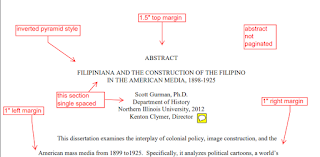

Templates and Examples: https://www.niu.edu/grad/thesis/templates-examples.shtml
Video Tutorials: https://www.niu.edu/grad/thesis/video-tutorials.shtml
In last month's "It's in the Guidelines," Tiffany explained how to access our many resources on the Thesis Office website. Knowing where to look up formatting help will save you a lot of time. Now, I want to add to her post in order to stress the importance of actually using these guidelines. That is, the guidelines not just there for you to look at them if you feel like it. They're there because you NEED to look at them. In the words of one of our Thesis Office mottos, "If you don't use the guidelines, you'll do it wrong."
For instance, you'll start off on the wrong foot from the get-go if you don't look at the abstract and title page templates. How in the world would you figure these things out by guessing? You wouldn't!
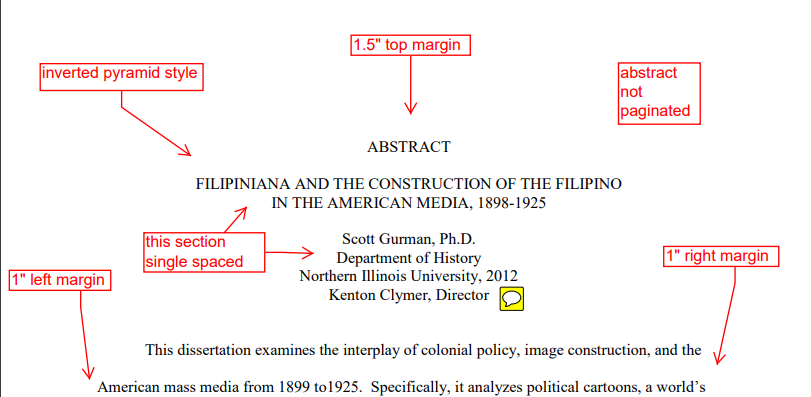
All successfully defended and submitted theses go through a revision process with this office. Why? To fix the formatting...which is explained in the guidelines. (I apologize if this is giving you flashback to "IT'S IN THE SYLLABUS"). Many students are surprised by how much more work they need to do. When they think they are completely done because they had a great dissertation defense, and then find out they have to make scores of corrections, it's kind of a buzzkill. If you've submitted your defended document on time, you will still graduate! But, the better that document looks at the time of submission, the more headache you'll save yourself. You should be planning a graduation party or looking for a job, not tweaking margins and re-labeling tables and setting fire to your laptop.
For another example, see the figure below. Figures and tables are labeled differently. Figures have the number and title below, while tables have them above. There are also different conventions for naming each, and their placement within the document. Did you think about that before? Some published students already know about such conventions, but many others do not.

There is a reason that some journals look great and consistent from cover to cover. An editor followed exacting guidelines to get it that way. The Thesis Office has exacting guidelines so that NIU sends documents out into the world that represent the high quality of the graduate scholarship done here. We want you to look great, because you are great!
 |
| more guidelines... |
Finally, the most common problem students come to visit us about is their page numbers. Unless you have published a book, you probably haven't had to wrangle page numbers a lot. We have a very informative video on how to do it, and the simple logic of it can save you hours. Check it out!
After seeing students' worst problems over the years, we know what needs to be clarified. Use the list of guidelines and the red-marked templates on our site, and you won't need to see so much red ink on your own document. Thanks for reading -- now go read the guidelines!
Templates and Examples: https://www.niu.edu/grad/thesis/templates-examples.shtml
Video Tutorials: https://www.niu.edu/grad/thesis/video-tutorials.shtml
Friday, April 19, 2019
It's in the Guidelines
If you
haven’t visited us in the Thesis Office or attended one of our workshops, then
you may not know that you can’t finish a thesis or dissertation without
referring to the guidelines. It’s important to know how to utilize the
guidelines and how to use them most effectively to make formatting your thesis
or dissertation simpler. You will need to learn several Microsoft Word
functions which you may not have ever needed to use before completing
coursework and may never need to use again, so allot time to familiarize
yourself with the software in your completion schedule. To begin with, download
and or print the guidelines so you can refer to them quickly often.
Begin implementing the formatting
outlined in the guidelines during drafting. Don’t wait until the entire document
is completed to reformat. Remember, while you’ll need to follow the conventions
of whichever citation style you’ve chosen, conventions of the Graduate School precede
those of all other citation styles and will sometimes conflict. The guidelines
alone may be difficult to understand without referring to them in conjunction
with the templates and example pages also available on the Thesis Office
website. Of all the procedures outlined in the guidelines, the two which often
present students with the most confusion are page numbering (including section
breaks and suppressing the page numbers) and leader dots. Dedicate the most
time to mastering these two functions of Microsoft Word first. Separate adding
and deleting section breaks and suppressing page numbers into two different learning
tasks.
It’s likely you’ll need to also supplement
the guidelines with Microsoft Office’s support website to view step by step
illustrations to complete both tasks. Bookmark, save, and/or print the examples
and templates from the Thesis Office website along with Microsoft Office’s
support website’s examples and you will have all the resources you need to make
sure your page formatting is correct! Do the same for adding leader dots to
ensure your Table of Contents is formatted correctly as well. Video tutorials
over leader dots and section breaks are on the Thesis Office website as well to
supplement the guidelines. Microsoft Word several templates for title pages, tables
of contents, etc. These templates will make formatting your document according
to the guidelines more difficult, so don’t try to implement them, though they
seem to present a ready-made, time-saving fix, they will create a headache for
you.
The guidelines cover any issue that
may come up during the formatting process, so refer to them first as the
definitive source along with the other supplemental sources mentioned. Of
course, if any other questions or concerns arise, we at the Thesis and
Dissertation Office are very familiar with the guidelines and are happy to help
you navigate and utilize them effectively and are available M-Th 10 am – 2 pm
and by appointment in Adams 104.

Thesis and Dissertation Office: https://www.niu.edu/grad/thesis/index.shtml
Thesis and Dissertation Office Guidelines:
https://www.niu.edu/grad/thesis/pdf/ETD-Guidelines-Dissertation.pdf
Thesis and Dissertation Office Templates and examples: https://www.niu.edu/grad/thesis/templates-examples.shtml
Thesis and Dissertation Office Templates and examples: https://www.niu.edu/grad/thesis/templates-examples.shtml
Thesis and Dissertation Office Video Tutorials: https://www.niu.edu/grad/thesis/video-tutorials.shtml
Microsoft Office Support - Suppressing Page Numbers: https://support.office.com/en-ie/article/start-page-numbering-later-in-your-document-c73e3d55-d722-4bd0-886e-0b0bd0eb3f02
Microsoft Office Support Leader Dots: https://support.office.com/en-us/article/show-dots-or-leaders-between-tabs-c80b62d0-2244-4078-95bd-8c82f91440ba
- Tiffany
Friday, April 5, 2019
Catastrophic Interruptions: On Writing the Dissertation (or not) When You Can't Write
by Robyn Byrd

I have a conference paper due in 10 days and a chapter deadline at the end of the month. But what have I been doing this past week? Driving almost 2500 miles across the country, and I wasn't on a much-needed vacation. I was moving my aging father from Arizona to Maryland (where family can care for him). Last Friday my sister called me in the middle of class, going out of her mind not knowing what to do. He had collapsed, unable to breathe, and was yet insisting on taking care of himself. Big Sister to the rescue! Dad is safe a week later.
And now Big Sister is another week behind on her chapter draft and her conference paper. Like many dissertation writers, I have experienced more than a few setbacks. The very length of the project makes it almost certain the writer will be set back by something -- be it poor health, caring for parents and children, divorce, or worse. A man I met at one of our programs was set back by his wife's death. Another was crying daily because he was fighting addiction. By comparison, taking care of my ornery father (love ya Dad) and getting a divorce in 2015 seem like minor inconveniences. But setbacks they were, so much that my dissertation completion schedule (presented at my proposal defense) seems like an unfunny joke by now.
So what can we do? While I'm not an expert on personal trauma or time management, I have lived through catastrophes of both, and can offer some wisdom for surviving and doing the thing. Because I am surviving and, ever so slowly, I am doing the thing.
1. Accept that you are behind. Adjust and move on.
A big part of moving on is acceptance, in any kind of bad situation. Getting behind on your dissertation -- like WAY behind -- because of a personal or family catastrophe is common. It happens to the most dedicated writers. Accept it, change your completion schedule, defer the graduation, make new plans. You have spent this long on the diss. If you still want the degree, still do it. But adjust your expectations for completion. You were going to miss being a student anyway. ;)
If your setback(s) help you realize you need to be doing something else? Do that instead. Many people decide, mid-stream, that they do not want to write a dissertation after all. Don't be tricked by the sunken cost fallacy. If doing something different is better for you, even after all this work, DO it.
2. Develop habits and routines. No, really.
You may have been able to manage your diss writing up to this point by getting a little done here and there, or having an informal schedule for doing work. Well, now that you are behind, and now that you know "stuff happens," get even more serious about your habits and routines. I bought a Panda Planner, and started using Trello.com to manage my time and work. The Panda Planner also lets me have daily reflections right on my schedule. Also, check out Tiffany's post about apps for writing projects. A combination of digital and physical planning methods works best for most.
Habits are hard to cement, so using planning and mindfulness you can develop them over the coming weeks and months. Don't get too ambitious. A single new good habit every month could put you months closer to defense. For instance, I have been working on going to bed earlier.
3. Don't compare yourself to others... unless it helps.
Personally, I do compare myself to others, because until recently I knew no other single moms in my program. Of course the other women can do it themselves! They have husbands or they're single. While it's true that I don't know everyone's story, it helps me to think this way and not hold myself to a standard of "five years to PhD" (the average in my program), simply because my life situation is not average. I'm a single mom; I got a divorce mid-grad career; my dad is aging fast and needs help; I'm low-income and need to work a lot of hours. All these things, plus setbacks, make me realize I can't expect to work as quickly as the others.
On the other hand, if you know you have trouble with comparing yourself and feeling insecure about it, develop a habit of NOT doing that! Talk to friends about it. Even people who don't Ph.D. They probably have similar problems at work. And don't forget -- you've had a setback. It's not an excuse. It's an understandable reason for not working.
----------------------------------------------------------
Setbacks are not the end of the world, and they're not even the end of your dissertation (unless you want them to be). Athletes experience setbacks in many of their seasons, and they don't necessarily throw in the towel. Stuff happens when you're working hard! Catastrophic interruptions happen at every stage of our lives, they just seem even more catastrophic when our lives are this tightly scheduled. Talk to a therapist, talk to friends, be mindful of you thinking about the interruption and its consequences. If you decide to keep going, your dissertation will get done. Just not as soon as you think. And that's okay.
Friday, February 22, 2019
Bullet Journaling for Motivation
Tiffany started you off on this Bullet journal journey with some gorgeous example templates for dissertation planning. For those not interested in the hobby of lettering, or those who want their entries to be quick and convenient, there is a whole sub-set of folks bullet journaling in a minimalist format. I tend to end up somewhere in the middle. Sometimes I spend time making my pages look cute, but I also use my bullet journal as somewhat of a workhorse. If I need to scribble down notes or ideas quickly, so be it.
There are plenty of places online to look for bullet journaling layout ideas (my favorites are Pinterest and Instagram), but I wanted to talk more specifically about how you can use your journal as a motivational tool. Writing a dissertation or thesis is a long process that requires sustained attention and effort, and a bullet journal can function as a helpful tracker of your progress.
Writing a dissertation or thesis is all about setting a series of goals. Due dates for your chapters, due dates for your research or literature review, due dates for sections of chapters, and finally goals for everyday writing. The latter is what I’d like to focus on here.
Most of the texts on dissertation writing agree that we should be working on our projects daily, whether that’s a 6-hour block of time or the 20 minutes you have on the train. It’s not always easy to see how those small daily efforts add up to you reaching your larger goal. Here’s a few things I’ve tried.
You could set up a word count goal for the day. I have experimented with making a sticker chart for myself like the ones we had in elementary school and giving myself a sticker per 100 words I write (thanks to Katy Peplin for this idea). It’s amazing how this little motivational tool still works. Our teachers were on to something. I got these stickers at the dollar store. You could use stars, hearts, or any other sticker shape you like.

Another method of tracking progress is setting time-based goals. I’m a huge fan of the Pomodoro Method, and I set up a pomodoro goal at the beginning of each month. I record these daily and count them up at the end of the month, but you could also use a sticker chart or adapt the idea of a mood tracker (i.e. fill in one space per pomodoro).
One of the great advantages to the bullet journal is having a physical space to organize your thoughts and track your progress. I’ve been bullet journaling for about three years now, and one of the things I love best about it is having a record of all the work I’ve done. Because results are slow in coming, it can be easy to forget the amount of work you are putting in. After I passed my comprehensive exams I looked back on my bullet journals and was able to see how many small goals I met before I met the larger goal of passing the exam. One day I read half a book, the next I transcribed my notes, and the next day I met with my study buddy. It’s like putting a bucket under a leaky faucet. Each drip makes the bucket fuller, and all these drops of water will eventually fill the bucket.
- Amanda
Amanda Roberts is a guest bloggerPhD candidate in the English Department at NIU. She is currently researching Tori Amos to complete her dissertation.
Subscribe to:
Posts (Atom)