Thursday, December 17, 2020

Know Yourself: Approaching Thesis Writing Through the Lens of Myers-Briggs

by Augie Morado

A few years ago, I got into the Myers-Briggs Type Indicator, a popular metric used for personality based in Jungian psychology. While clinical psychologists are more likely to use the Big 5 personality traits to assess personality because it is more scientific (i.e., based on observable behaviors) than MBTI, I find myself coming back to the latter.

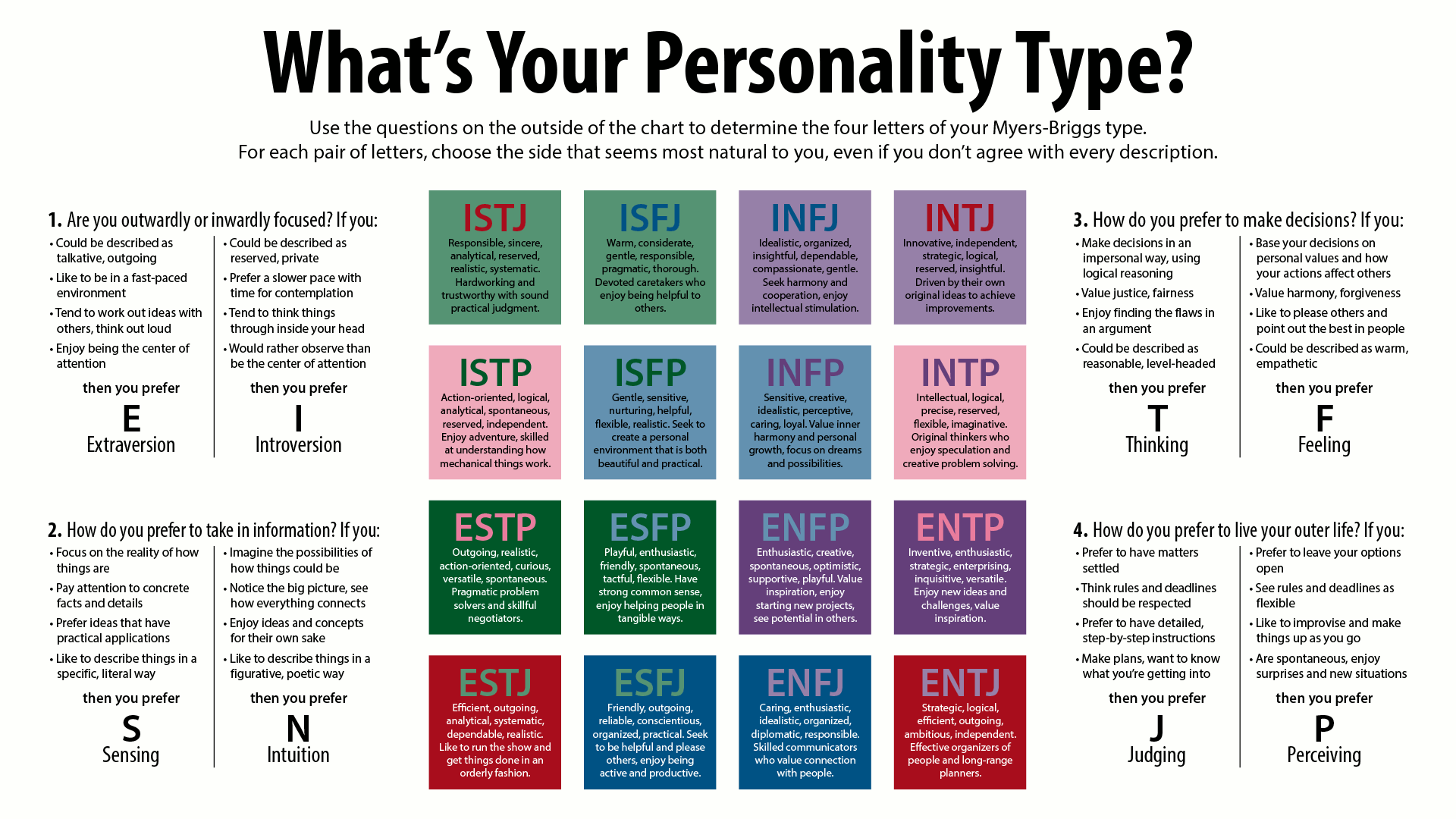
Without getting into the cognitive functions that underlie how it works, MBTI is simple enough, straightforward, and easy to assess for yourself: your personality type is represented by four of eight letters: Introverted (I) vs. Extroverted (E), Intuitive (N) vs. Sensing (S), Thinking (T) vs. Feeling (F), and Judging (J) vs. Perceiving (P). The site 16personalities.com is a good starting point – it has cute infographics and does a nice job explaining what your results mean for various aspects of your life. Other versions of the tests are a bit more technical, with some asking different types of questions and others that focus on those aforementioned cognitive functions.

 A Breakdown of the MBTI Types

Beech, Jake. (2014). Myers Briggs types. MyersBriggsTypes.png (1920×1080) (wikimedia.org)

I take a lot different tests from different sites, often for fun, and across the board I almost always test as INTJ. I’ve scored as INTP a few times and even got ENTP once when I was feeling really sociable, but I would agree that INTJ is my most accurate descriptor: I’m fairly reserved most of the time and work well on my own; I’m in my head more than I’m in the moment; I try to make choices based on objective data without letting emotions sway me too much (though I honestly feel like emotions play by some logical rules, too); and as much I have fun being occasionally spontaneous, I prefer to be organized and avoid leaving loose ends.

MBTI may not be the only metric by which we can know our personalities, but like any metric on its own, it’s a good starting point for discovering and understanding our strengths, weaknesses, and tendencies as well as the way we perceive the world, relate to others, and solve problems.

Once you have a clear idea of what your MBTI type is, you can apply that knowledge to a lot of things--in this case, how to approach writing your thesis or dissertation, regardless of where you are in the process. Even things as simple as planning your work schedule and knowing when to take a break can benefit from this insight.

As an INTJ, it’s been helpful lately for me to trust my intuition and make connections between disparate patterns among the sources I’m reading. At the same time, it’s also been helpful to stay focused on the broad conceptual level and not tweak my thesis every time new evidence or connections enter the picture. I have a clear vision for what I want to argue and unless something drastic changes, I plan to stand by it. On the other hand, knowing my type has also helped me be more aware of my weaknesses and areas where I can improve. Like I said before, I’m in my head a lot, and writing is a physical activity, something I’ve got to do in the physical world. Furthermore, resuming after a break can be overwhelming – finding the place where I left off, rereading feedback to know what to address, and being aware of what comes before and after so that the content I add and the gaps I fix make sense. 

There are lots of little sensory details than can be overwhelming to process all at once and keep track of, so it’s been helpful to practice being aware of little-picture things in all areas of my life: consistently organizing my workspace, keeping up with dishes and laundry, and lighting scented candles to make my workspace cozier.

In a basic sense, my strengths lie in staying focused on big-picture goals at the expense of embracing the smaller, more mundane (but just as important) tasks of processing and doing. On other hand, someone with, say, an ENFP personality type might excel at being open to lots of different ideas that emerge throughout the research process but struggle with buckling in and condensing those concepts into a singular vision. An ISFJ, however, might excel at checklist-like organization and take care in connecting research to the real world at the expense, perhaps, of welcoming lots of disparate ideas while writing, especially if those ideas are more abstract than practical.

No type is objectively the best or worst, and even two people of the same type may approach life differently due to different values, goals, and so on. Nonetheless, MBTI is a useful tool for knowing ourselves and understanding our potential. This self-knowledge has a wide range of applications, and you can definitely use it to develop better approaches to your thesis or dissertation.

Monday, November 23, 2020

Everything I Learned About Dissertation Writing, I Learned in FYComp

It’s been a solid year and a half since I’ve been in a classroom to teach. I took a break from teaching after the Spring 2019 semester to explore other GA work opportunities at NIU; this is how I came to be in the Thesis and Dissertation Office. During that time, I’ve been working on my dissertation proposal and struggling mostly with how to structure the document. When I began work on my master’s thesis in 2015, I wrote a proposal which I defended, and while I realized that my scope was a little broad, my advisors’ comments were helpful in narrowing my focus to something manageable for that project.

In recent revisions of my dissertation proposal, and looking ahead to what will eventually become the dissertation itself, it’s been helpful to review a few tips from past experiences, particularly from teaching first-year composition (FYComp), to regain a clearer sense of how to go about revising my work into something defendable.

See the source image
NIU FYComp Students in Spring 2014. Retrieved from Students: apply to become First Year Composition peer advocates - NIU Today

First, your introduction should be as much a map of your argument for yourself as for your reader. Regarding abstracts, one of my favorite pieces of advice to give students is to think of their abstract as the most concise version of their paper that can possibly exist; in some regard, the introduction paragraph/section is then an extension of the abstract, albeit slightly more detailed. And yet both should communicate to readers exactly how the thesis will be argued and what those paragraphs will more or less look like. In other words, there’s no pressure to reinvent the wheel with structuring your dissertation proposal: a conventional approach to outlining can be helpful in keeping you focused and communicating to your advisors what you plan to do.

Another thing I find helpful from FYComp is practicing genre analysis by reading others’ dissertations and proposals. I’ve had the good experience this semester of picking up some side work as an editor for a few Ed.D. students at Aurora University, where I also work as a writing tutor, so I’ve spent some time reading others’ capstone papers and getting a better sense of how these things tend to be structured and paced. Although the papers I have looked at were written for a different type of doctorate than the one I am studying for, it is still helpful to see not only how these dissertations are structured but also how they work – in other words, what purpose they serve, which is to make an original contribution to knowledge in the discipline. Unless your project is a mixed-media work – perhaps incorporating audio or film – you don’t need to do anything radical with form; content is the thing. Rely on tried and true conventions of those who came before you.

Building off that last point, it is still important to think about ways you can creatively present your research in a way that reinforces key ideas from your thesis. I try to keep up with emerging trends in FYComp and am excited to see that there is a shift toward multimedia writing projects such as videos, podcasts, and the like. Composition is so much more than just writing text in an essay format. As students and teachers spend more time online, we should think about how to make the best use of all affordances available to us as well as how we can work within the limitations of a given medium or set of media. Furthermore, we should think about ways to push the boundaries of how we can write and present research to others, even if that means we break some of the old rules that we take for granted. This isn’t to say that an all-text dissertation is bad or outdated (this blog post is mostly text, after all), but it’s not the only way to share our contributions to knowledge.

For example, my dissertation is on greentext stories. I am trying to think of ways that I can strategically share stories throughout the paper to support certain arguments but also to comment on the research itself. Greentext stories are folkloric, and thus they mainly spread either by copy/pasting or through repeated cues and archetypes. Since I will be duplicating some of the stories throughout the dissertation and even the proposal, I realize it is important to consider how else I can use them – perhaps in place of epigraphs to illustrate key themes discussed later in a section. In this way, I’m actually taking part in the folkloric process by reproducing these stories, so I will need to think critically about how I use them in this new context and what meaning they will convey.

Regarding your own thesis or diss project, regardless of where you are in the process, I encourage you to do two things: whenever you feel lost, recall the basics of FYComp and use those conventions to orient yourself, and then once you feel you’re moving in the right direction, think about novel, exciting ways you can share your new knowledge using the new tools.

Friday, October 23, 2020

“Hiring Yourself”: Maintaining a Steady Work Routine During COVID-19

by Augie Morado

The first few weeks of the COVID-19 shutdown in mid-March this year were kind of fun. I learned that almost all of my work as a writing tutor and grad assistant could have been done from home this entire time, plus I didn’t have to commute, which meant saving a lot on gas. The best part was that the students I spent the rest of the semester working with caught on quickly to the new challenges of working and learning remotely, an easy learning curve for most involved. All things considered, life was good, and this felt like something I could get used to.

At the end of the spring semester, though, I found myself with no regular routine except for chipping away at my dissertation proposal and periodically responding to feedback from my director. In the meantime, I tried picking up some new hobbies, including working out and watching movies.

Nonetheless, this summer felt like one of the longest ever. Worst part was hearing clichés being echoed: “This is the new normal” and “During these unprecedented times…” and “The days are just running together.” However, that last one actually rang true; after a few months of having little structure, I was finding it hard to make significant progress on my dissertation or to motivate myself to keep up with workout routines. I went through stretches of days where I felt too bored to even unwind with a video game.

So, imagine my joy when late August rolled around and I was back to my regular commute for work. Most of my appointments are still remote, but it feels good to do somewhat normal things again like packing a lunch and going for walks during my break and stopping at Target or Jewel on the way home to get things I need. Best of all, having a set work routine means making the most of my free hours for important projects and activities. Carolyn Law, who directs the Thesis and Dissertation Office, has coined a helpful phrase for those writing their theses and dissertations: “hire yourself.” You’re working free from direct supervision, but you owe it to yourself to stay accountable to structure your day in a way that energizes you.

I have my morning workout every day before breakfast (I have a CNA friend who recommends this: your metabolism’s at its peak when you wake up), shower and dress, then walk my dog – it’s important to exercise your pets, too. Then I prep and pack whatever food I’m going to eat for the day, track it in my Fitbit app, and spend some time before my work commute getting dissertation work done. If I have downtime at work, I chip away some more at diss stuff as well as creative projects I do for fun – I’ve given up the mindset of being a stifled artist burdened by work in favor of being a worker first and a creative person second (less pressure that way, and more fun). When I come home, I usually watch a movie or play a video game before winding down for bed – by this point, I’ve accomplished enough during the day to feel good about relaxing.

While I can’t speak for other thesis and dissertation writers who have spouses, children, and other obligations along with work, I think it’s important to adopt a routine if you haven’t already. I’m not saying you need to devote every minute of downtime to work, but it’s helpful to set aside time for constructive tasks that energize you. Even if you’re not directly chipping away at something work related, you’re making things easier for yourself to do so later. For instance, working out helps me wake up for the day and start off feeling accomplished; packing lunch, washing dishes, folding laundry, and doing other mundane tasks helps me feel more organized and saves time and stress in the long run; and writing a page of story or playing guitar are good outlets for creative energy in addition to work. So, as we continue to hire ourselves through COVID-19, think about what energizes you and find ways to make time for those things.